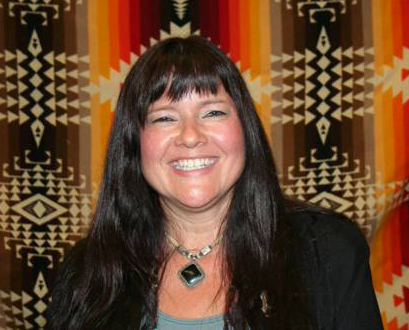
Nico Wind
Assiniboine Singer Roger White, Jr.
with Nico Wind
[audio:https://www.wisdomoftheelders.org/s2_progs/207_tr.mp3]Arlie Neskahi:
In Wolf Point, Montana, one young Assiniboine singer has been working to bring back tribal music traditions and learn old songs that haven’t been sung on his reservation for decades. On today’s Tribal Rhythms, Nico Wind takes us to the bottom edge of Assiniboine country on the Ft. Peck Indian Reservation to talk to singer, Roger White, Jr.
DOORWAY SONG
Roger White:
There’s a story behind how we got the drum, how it came to be, who brought it to us, you know, the Thunder Beings, and who helped us to sing our first songs.
Nico Wind:
Roger White, Jr. From Wolf Point, Montana is a member of the Assiniboine tribe. He is a young man, about 30, and a student at Fort Peck Community College. He tells of his family roots.
White:
So there’s two bands here on the Assiniboines here on Fort Peck. So one of them would be the Canoe Paddlers and I just happen to marry up with a Canoe Paddler.
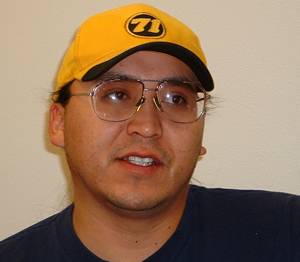
Roger White. Assiniboine singer. Photo courtesy of Milt Lee.
And I come from the Red Bottom Clan of Assiniboine, the Nakota, the Red Bottom Clan. And it basically means “Red Root” That’s what “hudesana” means. And the other being “Red Bottoms” they calling us the red bottom of that root. My dad’s family comes from here as well. They were Red Bottom people. And my mother’s family, she’s Dakota, so that’s where I get my Dakota blood.
Wind:
White works hard at keeping the old songs and traditions alive. As he talks about the early origins of the drum, we get a sense of life 50 years ago, when the Doorway Songs were last sung at Fort Peck.
White:
The rumbling (beats on drum) almost sounds like thunder when you’re hitting that drum hard. (loud drum beat) You hear it echo. You hear it thunder. (several beats) And you’re honoring those Thunder Beings. You’re bringing it. You’re pounding. How would you say the, “hmunbi,” I guess. And that’s how you say that drum, because you’re hitting it.
I kinda wanted to give you a little insight on how it used to be. How dedicated people were coming to these social gatherings. You know, they’d celebrate for four to five days, to visit, to share, and to help one another out.
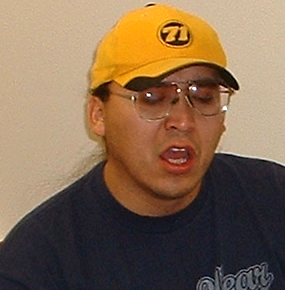
Roger White. Assiniboine singer. Photo courtesy of Milt Lee.
Everybody would come together. It’s not like it is nowadays. We’re kind of closed off in these, our houses, and that’s where we stay. Well, they would do this for four to five days. And before they would do this, well the lead singer used to go around and he would sing what we call nowadays Doorway Songs.
And these Doorway Songs were to entice his other singers to come and help him. He’d stand outside their home and sing until they came out. And when he had gotten all his singers gathered up, he would go around from house to house and he would sing out in front and they call these, some people call them Begging Songs, but I like to refer to them as Doorway Songs. They used to call it Counting Buckets.
DOORWAY SONG
Wind:
Seldom heard today, Doorway Songs were sung to gather what was needed for an upcoming community celebration. This Doorway Song was recorded by Willard Rhodes in the 1930’s on the Crow Indian Reservation.
White: They would bring out a food item to these singers, or they would come and say, “Well, for the Powwow tonight or tomorrow I’ll bring salad or I’ll bring something to feed.” So they always made sure before they left the house that they had received some type of monetary donation, whether it was money or blankets or, and that’s what they used to give away to all the visiting people that came. And that’s how the Powwows used to take place. And it was hardly for any contest and stuff like we have nowadays, you know. But long ago it was a lot different and a lot funner, I guess you can say.
(SINGS BUFFALO CHASER SONG)
Wind:
During the celebrations, they would sing what White calls a Committee Song or a Clan Song. White, a member of the Red Bottom clan, says they use the song to introduce themselves. This one is called Buffalo Chaser Song because of its close connection with the buffalo hunter.
White:
That’s Wataphevi. That’s, it’s basically saying:
“Our buffalo, the buffalo, where have you gone? The Red Bottom are your friends. We’re your people, you know. Where have you gone? We’re having a hard time.”
That’s what that means. It’s a buffalo chaser song for the Red Bottom Clan.
Wind:
When the Clan Song was finished, the singers would honor the cooks with a song.
(SINGS COOK SONG)
White :
These are the ones that are feeding you, you know. Respect them. And it was mainly the women. And they would carry the ladles for the cook song and to show that they were the ones that prepared all the fixings or food and whatnot for the celebration.
Wind:
From the first drum and the first song given to the people by the Thunder Beings, Assiniboine traditional life has revolved around music, stories, and songs. For Roger, the relationship began early on.
White :
See, I started singing when I was about three years old, so I kind of just grew up with the music, I guess. Me and my cousin, Nicole Heavy Runner, we started a group when we were about nine or ten years old. We were just young fellas. So then, he moved. He happened to move away. And we happened to meet up again about four years down the road. And we said, “Hey, we should go along with this, you know, start it again.” So, we kept the group name, kept going, and now it’s down.
Wind:
White is always on the lookout for songs. When he finds one, he is quick to pick it up.
White :
Oh, and I’ve recently got a song just like two nights ago. And my, my wife’s grandmother… now, it’s kind of odd. We went over there and um, she had bought a CD and she didn’t know how to work the CD player. And so she started humming around that, or a Kahomni from a long time ago. And I asked her if she’d hum it again. And you know, I’ve been in the family now for ten years, but I asked her to hum it again and she was really hesitant with me. But she, she hummed it again and then she told me the words, so I wrote them down and I kept the melody in my head. And I can sing that song for you.
ROSE LILY’S KAHOMNI LOVE SONG
White:
That’s a old Kahomni, I guess you would say, or love song. I guess what it’s saying is, “Wherever you go, Micante, my heart, is following you. We’re dancing. So wherever you’re at, that’s where my heart is always following you.”
Wind:
Tribal people around the world have constructed drums from logs, gourds, turtle shells, baskets and just about anything that can be hit with a stick. This sound – the heartbeat, the thunder, the rhythm, along with the songs, helps to keep the culture alive.
White:
A lot of good singers around here, and I think that’s one of the things that will keep us going in our culture is the singing. I mean even if you don’t know the language here, Nakonia, or your Dakota or Lakota or whatever you are. If you don’t the language, at least I see these young fellas out there. And they’re singing and that’s going to keep them connected to their roots and then where they came from.
So, I think, you know, by sharing our music and our culture, hands on actually with other people and educating them about it where, this culture’s going to go somewhere, you know, with everybody.
Wind:
For Wisdom of the Elders, I’m Nico Wind.
Neskahi:
Tribal rhythms is written by Milt and Jamie Lee, produced by Clark Salisbury and Larry Johnson, and hosted by Nico Wind.