Because It’s Traditional
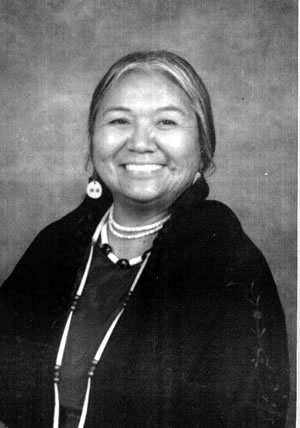 My name’s Vivian Harrison and I have my mother’s Indian name, StuYat. I was born right here on the Yakama Reservation at Harrah, my uncle’s house at a place called Charlie’s Pond. My mother’s mother was from the Palouse Band over towards Idaho on the Snake River. My mother’s father is from Spearfish, the WishramBand. My father is from the White Swan area, Yakama. So I’m completely Plateau and I was born in 1945.
My mother was a weaver and a bead worker and she was very proficient with taking care of salmon in every way. By that I mean cleaning it, cutting it, drying it, and preparing it in other ways. That’s a mainstay of our diet on the Columbia River and that was where I grew up.
My youngest days were at Spearfish, Washington, or at Celilo Falls. That’s where we were in the spring until mid-summer. That’s all she did during that time was take care of salmon. Then in the winter, she did the weaving and the beadwork. So I grew up watching her. She had made fully beaded outfits for my sister and me and when we went to the mountains we had huckleberry baskets that she made. When we went root digging we had root digging bags that she made herself that we used, the family used. On all these, this was our everyday life when I was young.
I began making tule bags or baskets about two years ago. The first one I made was about a cup and a half big and that was just learning how to manipulate and weave with tule, which is a fairly fragile plant once it dries. It has to be damp when it’s woven.
I saw a tule basket in the Yakama Nation Museum Archives and it’s small. I saw one at the Smithsonian Museum in Washington D.C. and that was about the same size. This tule basket as described in Lewis and Clark’s journals as was two feet tall and one foot across and it was filled with “ch’lay”, which is salmon that’s been dried and pounded to a powder. It keeps for weeks and weeks in that form because of the oils that are naturally in salmon.
These were disposable bags and the women made them to store, to pack ch’lay in. They put the skins of salmon on the inside-lined the bottom and the sides-then packed the ch’lay in there until it was full, and then covered the top with salmon skins. In this form, it was ready to be traded. There was a lot of trading of salmon on the Columbia River.
Tules grow in the marsh area, marshy land, wetland. It’s harvestable from the end of May until September.
What the women used long ago was to weave with is hemp twine. Hemp twine grows just in this area-the Plateau east of the Cascades. There are certain areas that the hemp plant will grow, which is in moist, moist land, not like the tule, which is a wetland. Depending on where the hemp grows how tall the plants get.The taller the plants, sometimes it’s better. Some tall plants are too dry and the fiber won’t break away from the plant as well. Certain places where the hemp plants grow are ideal for making twine.
My teacher was Helen Jim. When I first moved back to the Yakama Reservation and she taught me in about 1992. She ah, learned when she was very young and then set it aside. Then began weaving it once more in the seventies I believe. I’m not really sure. I didn’t ask her what when she restarted. She makes the basket hats, the “patl’aapa”.That’s what we call those types of basket hats.
She taught me first how to make the root digging bags. They’re called “wapaas”and we used commercial material to show me how to do that. Today I teach other people.
Our people have always used geometric designs. Before Europeans arrived we had bear grass that was used. When corn was introduced the women picked up that material quickly because it’s soft and pliable and plus it can be dyed into colors, natural colors.Although today people prefer the bright colors that are available with commercial dyes.
There are designs that are for mountains, for lakes, birds, people, salmon, sturgeon, deer, elk ah, thunderbird, and some petroglyphs, but on my small bags I use just plain geometric designs because that’s traditional.
Vivian Harrison
 Vivian Harrison, “Stuyat”, is a member of the Yakama Nation in the state of Washington. Her father was from the White Swan and Medicine Valley area on the western part of the Lower Yakima Valley located on the Yakama Reservation. Her mother was from the Wishxum Band who lived along the Columbia River east of The Dalles Dam. The terrain consisted of grassy hills and is always very windy. Her grandmother was from a village by the Snake River where the Ice Harbor Dam is now located. Jackrabbits and coyotes flourished in the sagebrush-covered foothills. Today the reservation is surrounded by different crop-yielding farms and orchards. The area ranges from semi-arid desert to the forestlands of the Cascade Mountains.
Vivian is a tribal historian, storyteller, and artist. Because of her work at the museum, she knows many stories that are mainly told to children at the museum. One of her stories is about her mother who was hidden from the Indian Agents when she was born so she wouldn’t be taken away to boarding school. She remained hidden until she was 18 years old. Vivian shares coyote, “Spilyay”, stories. Vivian also speaks about the environment. She spoke at Lewiston College concerning the marshes where materials are gathered, and their inaccessibility and contamination by toxins, which cause depletion of supplies that, affects artists and basket weavers today.
Vivian teaches American Indian Cultural Art at the Heritage University in Toppenish, Washington, and is a cultural teacher at the museum. She also holds classes in the art of making moccasins, buckskin and wing dresses, different techniques of beading and basket weaving. She first learned to do beadwork and then basket weaving. She speaks of one of the tribe’s well-known cultural artifacts that is a petroglyph on a cliff called “She Who Watches.” Another cultural artifact is called the huckleberry basket, which collectors call Klickitat baskets. They hold the huckleberries until they are preserved. One such basket was given to Vivian that her mother had made. Other baskets without decoration on the outside were used to cook in.
These are two of the items that Stuyat made, a two-gallon wapaas (root digging bag) and a replica of a time ball, that are on exhibit at the new Smithsonian National Museum of the American Indian in Washington, D.C., “Our Lives” featuring the Yakama Nation.
Vivian was a sun dancer at the Mt. Hood Sundance Society and also danced for the Blue Mountain Sundance Society and is presently a board member of the Blue Mountain Sundance Society, and a member of the NW Native American Basket Weavers Association. She has been whip woman for Treaty Days committee and has been Secretary for the past four years. She has also been whip woman for the National Indian Days committee. She is the keeper of medicine songs as requested by a friend who passed on. However, winter ceremonies are the only times she sings.
“If just one person I teach in each year of the rest of my life will practice these traditions and pass on this knowledge to others.it is good.”
Vivian Harrison
PO Box 1322
Toppenish, WA 98948 509-865-3634
stuyat_Harrison@yahoo.com