Sonny and Cher and the North Dakota Getaway
 One of the things that really compels me is the problem with history, especially the history of indigenous people. Then last my own history, where do I fit in as a native woman? How do my experience and the experience of a native individual speak to the group as a whole?
As a Cowlitz woman, my position is not unique and yet highly unique because the Cowlitz is a highly adapted group. They never cut a tree. They never had land and so to survive they had to blend in. They got jobs, they roamed, lived in different places, and yet throughout time, and we’re speaking over 150 years, they managed to keep it together as a group and keep it together as a people. But as young people, I think my experience is that the Cowlitz group is very characteristic as a whole. Asking how do we make it happen, how do we fully become Cowlitz and how do we attach to a people? So I wrote this little piece piecing together my identity. It’s called Sonny and Cher and the North Dakota Getaway. In other words being one of the next generations of Cowlitz way back in the 70’s.
In my family, it was the women of my mother’s side who were demonstrably Indian, but my grandmother and great grandmother could not be bothered with explaining what it was to be Indian. They were too busy being Indian, or rather, forgetting to be Indian. It was my mother, Sharon, who most clearly remembered for me how she was Cowlitz, but not through tribal meetings, or ceremony, or even the white man’s genealogies. Although I was raised by my great-grandmother and my mother to be proud of my native heritage, none of the traditions and lifeways of my tribe were explained to me or contextualized for me. My mother had no language to describe our native lifeways and, hence, no direct way to describe our experience, and yet and though I was raised with a quiet awareness of belonging, one I am still trying to understand. I grew up fishing, hunting berries, eating venison, digging clams, and picking fern. These were merely the motions of my everyday life, caught and woven into the memory. My mother never talked about these common acts as tribal, though I do believe that they were and I do believe that they are. She taught me through the radio instead, the popular culture of the mid-1970s: through resistance to Paul Harvey’s conservative radio rants, through admiration of the Cherokee Armenian superstar Cher, but not her husband, Sonny. As James Clifton has noted, the 70s brought a native renaissance, and my mother seemed to respond to it. In 1974, as we drove to North Dakota to visit my Norwegian stepfather’s relatives, the memory of Dennis Banks still fresh: brave in deep Dakota, holding off the Feds with a pitchfork, as Cherokee People blared on the radio. The long, straight stretches of an endless Montana seemed to hum, Cherokee people will return. I was nine or ten. I liked thinking I was an Indian who would return. But Where? I was never sure. Thinking he was stealing her for the hatred that ran thick as blood in the Dakotas those days, red versus white, I remember my father saying to my mother, flat-out, don’t tell them you’re Indian. His remark was essentially heard as a challenge by my mom who was paler than my grandmother and able to pass for white. Later in the trip, we visited my stepfather’s best friend, a Sioux man, living on government land he had inherited. I played in a river near his property with his chubby blonde children, slapping the water with the back of my hand. It fractured airborne, breaking in drops, reflecting the day, the blue-white sky, and the red earth.
My mother also taught me about being Indian through pithy aphorisms. She likes to think she’s a squaw, still thinks the word squaw is okay, and she’s famous for spouting essentializing indignities like those Cree Indians, they were mean as hell! That’s why we’re mean; we got this streak (like so many natives, we are a mix of Indian blood and so we are also Cree, not just Cowlitz). Sometimes it was a quieter, but perhaps more authentic knowing she passed, as when she’d tell me about growing up in Washington near to the land her native kin, the land that we had been on for thousands of years, in a place called Pigeon Springs. She’d share stories of Great Aunt Lucy out by the well singing a song in the Salish language. “It was pretty, it was haunting, my Mom would recall, and I would embroider the memory, as it seems my place to do, imagining Lucy’s lost song twining above the pine of Pigeon springs, lilting and eventually silent. In the silence, I began to listen and ask questions. I began to construct my identity as Indian. It was there, and like others of my age and generation in the Cowlitz Tribe, I began to see through its seeming opacity. I began the process of learning what it was and what it might be, to be a Cowlitz Indian.
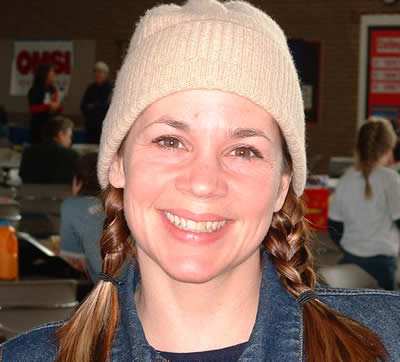
Christina Dupres
Christine Joy Dupres’ tribal affiliation is Cowlitz. She resides in Portland, Oregon.
She is a descendent of the Lower Cowlitz and the Cree of Manitoba, Canada. She is the descendent of Lucy Skloutwout and Louis Garrand or Guerin. Her Indian great-grandmother, Rose, was active in raising her. Chris’s mother taught her to identify with her native heritage and lifeways, and she was raised working with plants, picking berries, and harvesting fish runs. She feels at home in the forest. She was also raised by her grandmother and parents in mainstream culture and has spent a lifetime reconciling the seeming contradictions of her native lifeways and mainstream influences. She is captivated by the strength and continuity of the native voice and contemporary native culture and loves to speak about it. She likes to trace the path of its evolution. She is amazed by the power of the native spirit.
The Cowlitz Tribe as yet has no reservation land, but it does have administrative sites in both Longview, Washington, and Toledo, Washington. At one time the Cowlitz had many villages along the Cowlitz River and villages near Longview
Once, the Cowlitz roamed in southern Washington in an area known as the Island. That island today is called Sauvie Island. They roamed west to the coast, but they were not coastal people, rather they were a river and prairie people, who gathered and hunted at the base of Mount Rainer, and along the Columbia, Lewis, and Cowlitz Rivers. They were among the first of the southwestern Washington tribes to have horses and are very proud of their horse heritage. The Cowlitz terrain is characterized by land cut by ancient floods, and prairies shaped by ancient fires. In Oregon and Washington, the land is heavily forested.
Chris gives presentations in all types of settings. She loves audiences of all sizes and especially enjoys talking about contemporary native culture in the northwest to children and elders. As a historian and storyteller, Chris likes myths and legends, which frequently involve animals because humans didn’t appear in history until later. She shares stories of the Cowlitz legends and history starting with European contact in the 1830s. She discusses the impact of first contact on native people, disease contagion and the aftermath, how they endured to maintain native identity and survival in the face of overwhelming odds, and what others may consider erasure.
Chris specializes in contemporary native issues regarding sovereignty, and federal trust relationships and is best qualified in the area of Washington tribal history and northwest Native American issues. She is a Certified Washington State Teacher of Native Culture/Language and can provide training, technical assistance, mediation, research, and information dissemination upon request to help maintain state goals to work cooperatively with tribes. She received consistently excellent teaching evaluations as a college instructor in multiple disciplines.
Chris has written numerous articles in publications, including the Journal of American Folklore, American Folklore Society, Western Folklore Society, Library of Congress Field School, and the Philadelphia Folklore Society.
- Chris’s education and professional experiences include:
- PhD. candidate, Folklore University of Pennsylvania, Philadelphia 2005
- M.A. Folklore University of Pennsylvania, Philadelphia
- M.A. English University of Oregon, Eugene
- Teaching Certified in Washington State; Native Culture and Language
- Field School Certification Library of Congress, Indiana University
- B.A. English, University of Oregon
- Linguistic Consultant, American Indian Administrative Grant, Cowlitz Tribe
- Summer Intern for the Philadelphia Folklore Project, Pennsylvania
- Production Assistant for the Instructional Media Center in Eugene, Oregon
- Community Integration Specialist: Housing for the Handicapped in Corvallis, Oregon
- Chris’s achievements, awards, conferences, and publications include:
- Fontaine Fellow Dissertation Year Fellowship
- Education Chair, Cowlitz Education Commission
- Cowlitz Tribal Council Member
- Vice-Chair Cowlitz Tribal Cultural Committee
- American Indian Graduate Center Fellowship
- Graduate Student Mentor, University of Pennsylvania
- Graduate Student Representative to Faculty, University of Pennsylvania
- Certificate and Award of Achievement for Excellence in Teaching University of Oregon
- Fontaine Fellowship, University of Pennsylvania
- Sarah Harkness Kirby Award, Best Essay by Graduate Student, University of Oregon
- University of Oregon Student Union Film Award
- Graduate Teaching Fellowship, University of Oregon
- Graduate Admissions Committee, Department of English, University of Oregon
Christine Dupres
35 NE Jessup
Portland, OR 97211 503-473-9144
ctd@sas.upenn.edu