Robert Miller
Robert Miller on George Drouillard
with Robert Miller
[audio:https://www.wisdomoftheelders.org/s2_progs/201_tis.mp3]Robert Miller:
You mean you don’t know who George Drouillard is? Well, he was only the most important person on the Lewis and Clark expedition, after Lewis and Clark themselves, of course.
Arlie Neskahi:
Today, on Turtle Island Storytellers, Robert Miller, shares his knowledge about an often overlooked member of the Lewis and Clark expedition, the French and Shawnee woodsman, George Drouillard.
Miller:
I’m telling you that George Drouillard was the third most important person on the expedition. And lots of historians and writers agree with me. Primarily, this was so because Drouillard had so many useful skills and talents. For example, Drouillard provided most of the food for the expedition. He served as the chief hunter and Captain Lewis always had Drouillard out hunting. In fact, Drouillard spent lots of time during the expedition traveling on his own ahead or behind of the main body of men because he was hunting game. Captain Lewis in fact wrote in January, 1806 that he did not know how the expedition would have survived, “were it not for the exertions of this excellent hunter.” Why in fact the men ate 9 pounds of meat a day, when it was available, so you can see that Drouillard had a lot of work to do to feed 50 some men. And even though George was not in the army, he was so skilled at hunting that he was always made the leader of any hunting party Lewis and Clark sent out.
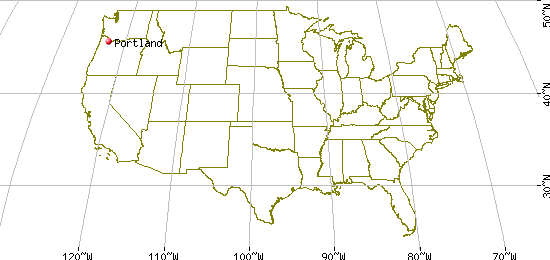
Portland, Oregon. Map courtesy of the U.S. Geological Survey. www.usgs.gov
Furthermore, because Drouillard was so brave and levelheaded, he was the first man both Lewis and Clark called out whenever they were going on side trips or possibly dangerous excursions. Lewis wrote after the expedition that Drouillard had been involved in all of the most dangerous and trying events of the voyage and had “uniformly acquitted himself with honor.”
Drouillard was no stranger to danger. In July 1806, for example, when Lewis and four men had a run in with Blackfeet Indians and two Blackfeet were killed, George was along and right in the middle of the events as usual. This was not the last encounter George had with the Blackfeet because in 1810, while George was fur trapping near Three Forks, Montana, in southwest Montana, he was killed by Blackfeet Indians. Maybe the Blackfeet hadn’t forgotten his part in the death of two tribal members during the Lewis and Clark expedition.
Drouillard was also a crucial factor in the success of the Lewis and Clark expedition because of his knowledge of many Indian languages and his skill with Indian sign language. In mid-August 1805, when Lewis was trying to gain the trust of the Shoshone tribe and buy horses from them to cross the Rocky Mountains, Drouillard and his sign language was the only source of communication with the Shoshone. This moment was so important to the expedition because Lewis knew that without horses to help cross the mountains, the expedition would fail. Lewis was desperate to buy horses and Drouillard was the only person that could help Lewis befriend the Shoshone Indians and to buy the horses they needed.
Drouillard was born between 1773 to 1775 in Canada to a Shawnee Indian mother and a French Canadian father. He migrated with his mother’s people to the United States when he was very young and he lived in the Cape Girardeau area of Missouri. A letter to his sister still exists which shows that Drouillard could, no doubt, read and write.
There is also evidence that George worked for the U.S. Army several times and in trusted capacities even before he joined the Lewis and Clark expedition. In fact, Drouillard and his work with the U.S. Army were mentioned in letters to General Anthony Wayne, in 1795, and to General James Wilkinson in 1797 because George was apparently involved in interpreting and carrying messages on several important missions. In addition, the 1795 letter says that George spoke seven Indian languages and had learned English in just six months.
Lewis & Clark met Drouillard at Fort Massac in southern Illinois in November 1803 on their way down the Ohio River to St. Louis. Lewis and Clark wasted no time in hiring Drouillard. They either already knew of him and his talents or they must have been told right away how valuable George would be because on November 11, 1803, the very same day they arrived at Fort Massac, Meriwether Lewis wrote in the journals that he hired George Drouillard as an Indian interpreter, and agreed to pay him $25 a month. Meriwether Lewis even ordered the military agent at Fort Massac to immediately advance Drouillard $30 pay. $25 a month was a lot of money! It was 5 times more than the enlisted men of the expedition received. Drouillard’s pay was different, you see, because he was not an enlisted soldier like most of the people on the expedition but he was a civilian employee of the army. And he was worth the extra money, truth be told, because his contribution to Lewis and Clark’s success was more important than just about everyone else on the expedition.
Drouillard must have been a thinking man too, because he took his time deciding for sure whether to go all the way to the Pacific Ocean with Lewis and Clark. It wasn’t until Christmas day 1803 that Clark wrote that Drouillard had agreed to go for sure, for the $25 a month pay, but only after he was allowed to settle some personal matters.
The Lewis and Clark journals demonstrate the magnitude of the responsibilities Lewis and Clark put on Drouillard and the trust they showed in him. Because of these skills, the captains sent him out to meet Indians and tribes as an advance man several times. Numerous other times, for example, he rounded up the explorer’s horses, and brought in other strays from the plains. Even though he wasn’t in the army, the captains even sent him after expedition deserters because of his tracking and woodsman skills. Drouillard also helped Clark draw his maps by giving him information he gained while out hunting and by helping to interview Indians to get geographic information. William Clark credited Drouillard for bringing him lots of this information. Even after the expedition, on a return trip to St. Louis, Drouillard gave Clark more information to add to his map of the west.
But the most important fact that demonstrates Drouillard’s contribution to the expedition is that whenever Meriwether Lewis or William Clark set out alone, or went on a side mission, they always took Drouillard because of his bravery and his skills as a scout and wilderness man. I guess it’s no surprise to you then that when the expedition was over and safely returned to St. Louis that Lewis and Clark trusted Drouillard to take their letters to President Jefferson and to their families to the Cahokia, Illinois post office!
After the expedition, George returned several times to the places he had visited with the Lewis and Clark expedition. He became a partner in a fur trading business on the upper Missouri and Yellowstone Rivers and he helped establish a fur trading post at Three Forks, Montana, in southwest Montana. It was near that fort, in 1810, that George died at the hands of the Blackfeet Indians. That’s the story of George Drouillard: the third most important man on the Lewis and Clark expedition.
Neskahi:
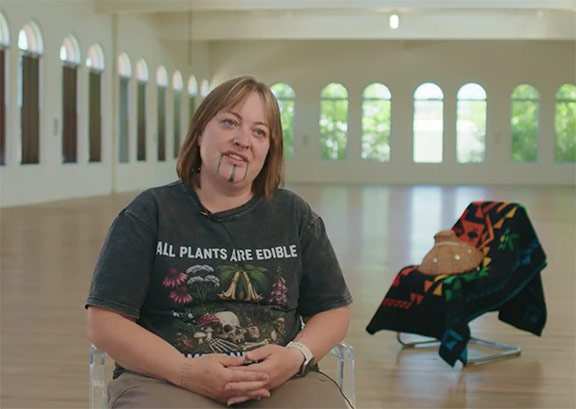
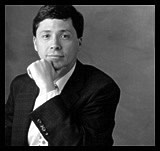
Robert Miller is an enrolled member of the eastern Shawnee tribe of Oklahoma and an assistant professor of law at Lewis and Clark College in Portland, Oregon.