
Horace Axtell. Photo by Stan Hoggatt. Courtesy of Western Treasures. http://www.nezperce.com/npphoto4.html
Horace Axtell
with Brian Bull
[audio:https://www.wisdomoftheelders.org/prog303/mp3/303_ew.mp3]Arlie Neskahi:
Becoming a tribal elder is more than just “getting old.” There’s a lifetime of lessons, which call for much reflection and soul-searching. There’s also a commitment to preserving tradition and passing it on to younger generations, to keep the heartbeat of a nation alive. Horace Axtell is a Nez Perce elder who’s seen wars, racism, and his share of personal loss. But he’s also experienced reconciliation, friendship, and forgiveness. In today’s Elder Wisdom, Brian Bull shows how Axtell’s gift to find the silver lining behind any cloud has helped his people thrive and celebrate their heritage:
Brian Bull:
Horace Axtell has spent his life cradled in “The Valley,” a rustic canyon area in Northern Idhao, sliced deep by the Clearwater and Snake Rivers. Axtell’s silver braided hair shimmers like sunlight on water, betraying his status as an elder. Axtell says it wasn’t an easy path. There were connections to be made with his family and culture, and even a reconciliation. This meant seeking out someone who had hurt him deeply as a child:
Horace Axtell:
I always remember my mother telling me, “That man standing over there is your father. So why don’t you go tell him ‘hello’?” So I was just a kid, you know, I’m not very tall. I went over there and he was talking to some of his friends. And he looked at me, never said a word. Then all of a sudden he turned back and kept on talking with his friends. And I stood there for a little bit, and finally I walked away. That did bother me a lot in my life. Growing up without a father is difficult.
Brian Bull:
Axtell never gave up on his father, but duty called after America entered World War II. Axtell joined the army after learning his father had enlisted. The two never met overseas, but Axtell’s mother died while he was away.
Horace Axtell:
And when I came back in 1946, I had no mother to come back to and nobody waiting for me at the bus depot or anything. And also, our house was gone, and life was pretty rough there for a while. Finally I found Grandmother. I really loved my grandma. It was so good to be with her, because the language, it made me feel so important and strong again”.
Brian Bull:
But his grandmother passed away, and Axtell went to work at the Potlatch Lumber mill, a large employer for many locals. Through his co-workers, he learned that his father was living in the town of Kamiah, and was doing a lot of heavy drinking:
Horace Axtell:
So I found him and he was drinking. And I talked to him. I told him, “I come up here. I heard you been drinking a lot. And I come up here after work to look for you and offer you to come and live with me. And I’ll take care of you for the rest of your life. But that you’re my father and you’ll always be my father. But I want you to understand one thing. I want to forgive you for not being my father when I was growing up. So this, this bothered him, even though he was drinking and made him cry. And I guess finally he decided he’d come live with me.
Brian Bull:
Although their relationship was often tested by drinking binges and sudden disappearances, Axtell says over time, he and his father began to connect more and more as the men shared their native tongue. this lead to an unexpected turn in his father’s life:
Horace Axtell:
One day they was having like evangelistic meeting out here at Spaulding Church right over here. And he asked me if I’d bring him out there for that. So I brought him out and he sat down in front, and he started singing these translated hymns, and I could hear him singing. He remembered all this. And, and so I think, “Well, it, it’s probably pretty close to the end of the service, so I went out and got in the car. It was in late November. I got in the car and warmed it up so Dad wouldn’t be cold when he got in. He was getting up in age. “Finally he came out all by himself. And he come over and got in the car, and he told me in Nez Perce, he says, “Son, I became a Christian.” Ah, my heart felt so good. I’m glad,” I said.
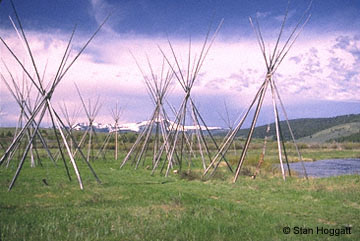
Big Hole Battlefield. Photo by Stan Hoggatt. Courtesy of Western Treasures. http://www.nezperce.com/photonp2.html
So we went on home and he went to bed. And I went to work early the next morning, and I come back from work that night and I looked in his room. And he was reading a Bible. And so I left him alone. That’s where his ah, Christianity began”.
Brian Bull:
Axtell began learning more of his family’s history through his father, and from many of the Nez Perce elders. tribal stories, legends, and the language were shared in the sanctity of the sweat lodge, where Axtell got to know many of the tribe’s most prominent members.
Horace Axtell:
And, some of the men folks were veterans of the War of 1877. And I had the honor of sweating with them and I listened to them tell stories and talk inside the sweathouse. They always talked about this man called (L). So one day when I asking my father all these different questions about things about and I told him this story about people talking about this man. And I had looked over and he was quiet. And I looked at his eyes and he had tears in his eyes. And I said, “Well, what’s the matter, Dad?” And he said “That’s my great grandfather.”
Brian Bull:
Axtell had reconnected with his father – now he was connecting with an ancestor. He kept asking around about his great grandfather’s story, and got an insight into his courage during the Nez Perce war of 1877:
Horace Axtell:
And one incident during the war down at Big Hole Battlefield, when they got attacked down there that morning. My grandfather, he got behind a big tree, and he sat down and he began to sing his power song. And he sang there all the way through, and hard and loud as he could. And started beginning to chase the soldiers down the hill. And all the way through that battle he sang his power song, so that’s when I realized again that he, he was a powerful man.
Brian Bull:
Axtell’s knowledge of both the traditional language and history of his people gave him a good reputation among the Nez Perce elders. He recalls seeing a car full of elders arrive at his home one night. Five women and two men got out and approached Axtell with a special request.

Unloading Logs at Potlatch Lumber Mill. Courtesy of M. Reusser Collection.
Horace Axtell:
They said, “We come down to talk to you. We’re really concerned about the old way of life, the old spirituality of our people, the old Nez Perce way that they themselves found out how to worship. And we have strong ways. And especially we’re worried about the burial of our people.” There’s a lot of our people that don’t belong to Christianity, but when they die, they have to be buried somehow. So they take them to the church and, and with a church funeral. We know that they were believers of their ancestors, the old ways.” So they said, “Since you can speak the language real good, we’re proud of you because we hear you talk. So what we want, to learn from you is how you feel about this way? We don’t want to know right now, but you, want to give you time to think about this.”
And so I thought about it for a couple of weeks. And I run into one of these old ladies. So she asked me if I made up my mind. And I told her right there. I said, “I’m willing to try.” Said, “I don’t know a thing about this old ah, Nez Perce way of life, the spirituality that we have. But I’m willing to try to learn.”
Brian Bull:
Axtell has learned, so much that he’s sought out by both tribal members and non-Indians to talk about history, language, and traditional native values. But he reminds himself that it took perseverance and love to connect himself to his family and tribe, and he wants others to think positive as they attempt the same path themselves.
Horace Axtell:
I always go back to the time I forgive my dad. You’re not supposed to walk around with a negative feeling, because if you do, you’re, whatever you’re doing, you think you’re doing the right thing. But this negativity is right with you and it is going to be there unless you let it go. Don’t do that. So I try that. We have to try to go around these negative things and do what we’re supposed to do. That’s our way.”