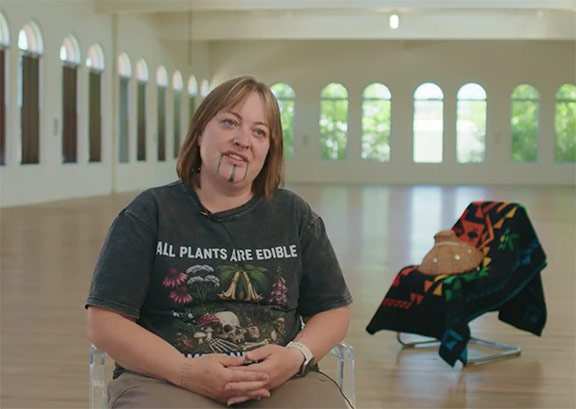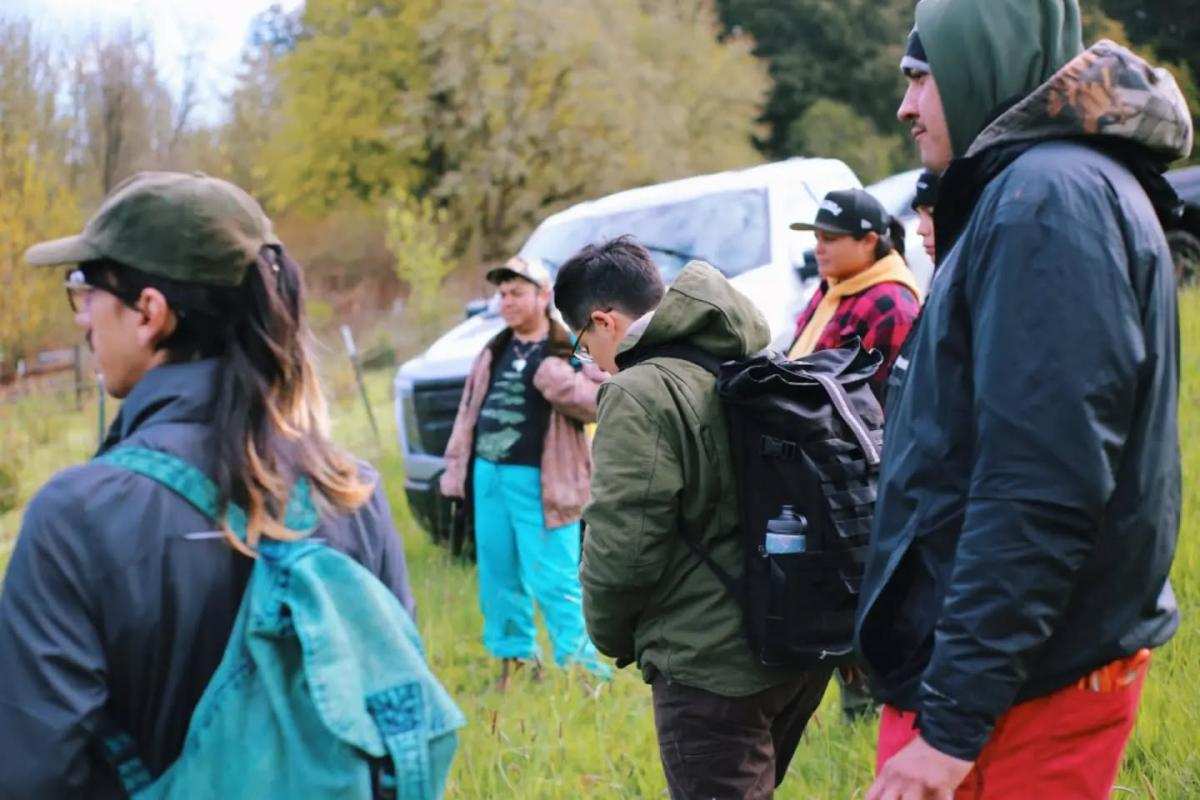

Emma George
Leo Ariwite, Rod Ariwite and Emma George
with Brian Bull
[audio:https://www.wisdomoftheelders.org/prog301/mp3/301_ew.mp3]
Arlie Neskahi:
Sacajawea stands out as the most prominent of the Lemhi Shoshone, yet some Shoshone question her role in the expedition. It helped facilitate westward expansion, eventually affecting her tribe’s homeland and traditions. The forced relocation of the Lemhis to Fort Hall, Idaho in the early 1900’s is also a painful chapter for many tribal members, who still long to return to their ancestral homeland in Salmon, Idaho. In today’s Elder Wisdom, Brian Bull explores the determination of the Lemhi people to hold on to their cultural identity.
Brian Bull:
Rod ariwite knows his ancestral home is now largely the stuff of legend — rivers full of fat salmon, eagles peering from towering trees, and hillsides brimming with berries and other foods. While ariwite’s ancestors were the ones forced from their homeland near current-day salmon, idaho, he and other Lemhis still see themselves as refugees – driven away from the craggy forests and canyons which sheltered and fed his forefathers.
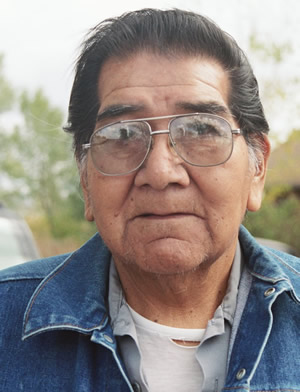
Leo Ariwite Photo by Larry Johnson
Rod Ariwite:
It’s just a way of life that has, no longer available to Lemhi people. Even though we go back still because we’re so attached to the land, that’s the land of our forefathers, where our parents and grandparents, and their grandparents have given their life, shed blood, shed tears so that we can call that “the land of the Lemhi people”.
Brian Bull:
Ariwite says between a reliable food supply and protection from nearby enemy tribes, the mountainous terrain provided the Lemhi of the early 1800’s with a good life. Then one day, his people were greeted by the Lewis and Clark Expedition:
Rod Ariwite:
They come into our valley as starving explorers and we were the tribe sitting over there with the horses and the good diets. And when they asked for our help to find a passage to the pacific ocean. And if we knew what happened to us today, living on another reservation, I don’t know if we would have provided the assistance.
Brian Bull:
Settlers began trickling – and then cascading into the country. By the late1850s, many Mormons had arrived, established a fort, and developed irrigation projects in the region. One of the Lemhi leaders, Snag, worked to keep relations between his people and the settlers peaceful. Lemhi educator Emma George says it was a valiant, but tragic effort:
Emma George:
Snag, he was traveling up to the ancestral lands in what is now called Bannock, Montana. He was in a hot springs bathing and he was murdered. The chief of the Lemhis was killed.
And this man, Buck Stinson. He scalped Snag and he took his scalp into the saloon and had it on a stick and was waving it around, saying, “I killed a chief. I killed a chief.” That’s one of the stories that you’ll hear from Bannock City.

Rod Ariwite Photo by Larry Johnson
His nephew, he was a war chief. His name was Tendoy. He had to promise Snag that he would continue to have a good relationship with the white people. The next day he came to Bannock City and he went out into the street and spoke eloquently in front of the people of Bannock City.
And he asked them, “Why, why this was done? Is there no remorse? Is there no compassion?” He says, “Our people are a peaceful people and we wish to remain that way.” And he says, “I come before you today, despite the fact that my uncle was killed.” He says, “I will continue and I ask that you as well continue to keep peace”.
Brian Bull:
Tendoy attempted to keep peace between his people and the U.S. government, even as wars were breaking out between the army and the neighboring Nez Perce and Bannock Nations. But despite the tribe’s intentions, in 1875 their lands were whittled down to a one hundred square mile reservation along the Lemhi river. They did their best to survive and prosper, but even this tiny parcel was coveted by the arriving farmers and miners. Chief Tendoy died just months before the Lemhi were forced from their beloved homeland in 1907. On the 200 mile journey south to the Fort Hall reservation, hills and mountains carved by rivers, carpeted with trees, gave way to scrubby, barren landscapes. Leo Ariwite says the difference was apparent even when he grew up:

Lehmi Pass, Courtesy of Beaverhead-Deerlodge National Forest www.fs.fed.us (click for larger image)
Leo Ariwite:
Nothing there. Burned sagebrush to warm me up. There was no wood around there. Eat the jack rabbit and fish. Grasshopper, that’s all we eat.”
Brian Bull:
Many Lemhi Shoshone refused to let go. Families would come back and set up semi-permanent camps around salmon, which allowed them to stay for awhile and hunt and fish.
Leo Ariwite:
Yeah, we went back over there in `43, `42. A lot of food, not like on the reservation. I used to go fish every day and get steelhead, fish, everything. You can kill deer, anytime you want.
Brian Bull:
Many white landowners encouraged the Natives to return, sympathetic to their need to come back. Fort Hall resident Emma George:
Emma George:
I make my home here, but my heart is in the Salmon River country where the river flows, the blue skies, the beautiful mountains. I can identify with how my ancestors felt about that valley. It’s a part of the heart, part of the soul. And a part of who we are and what we are, and to deny that, that’s denying ourselves.
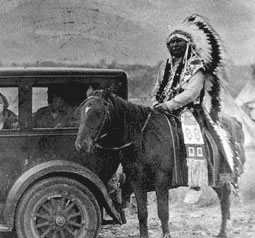
Chief Tendoy, 1800's, Courtesy of Sacajawea's People http://lemhi-shoshone.tripod.com/index-3.html (click for larger image)
Brian Bull:
The Lemhi, seen as latecomers who were expected to assimilate with both the dominant culture and that of the resident tribes. Emma George recalls how the Lemhi’s revered ancestor was regarded by some of the Shoshone-Bannock.
Emma George:
When I came to fort hall and said you know, “I’m a Agaidika.” And I had heard comments about Sacajawea and they were hurtful. People said, “She was a traitor. She went and brought the white people here.”
But I do believe there is a purpose and I do believe there were prophecies that the white people would come. And that happened. And I think that we’ve come full circle. I can’t say exactly, but it’s for good intentions, for friendship.
Brian Bull:
Emma George says in time, she was able to connect with Sacajawea, and set things straight with the help of traditional elders:
Emma George:
I believe that our ancestors are living in the spirit world, and I believe that her spirit was at unrest because of what happened to the Indian people. And my families and elders, they went back to North Dakota. And they had met with some Sioux people. And these Sioux people had told them that there was a lady crying by the river, by the banks. They said it was a spirit and they could hear her in the evenings and they could see a silhouette, and they could hear her crying. And they believed her to be Sacajawea crying by the river, because of what had taken place amongst our people. And she wants things to be right with good intentions.
And our elders, our people went back there and they met with those Sioux people. And they had a pipe ceremony. And they prayed for her spirit and they prayed for our people. They prayed for “the people.” And they had said that since that ceremony, that spirit was at rest.
Brian Bull:
For the Lemhi residents of Fort Hall, the long road home still leads to the rushing waters of the Salmon River and craggy bluffs teeming with wildlife. Many hope to win federal recognition. Those who make the journey with their children and grandchildren can appreciate the bittersweet legacy their ancestors left for them – one of peaceful reverence and an enduring devotion to their homeland.
For Wisdom of the Elders, I’m Brian Bull.