Lillian Pitt
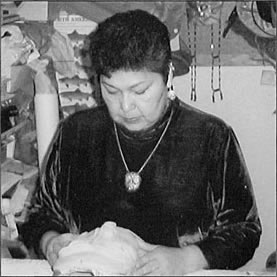
Lillian Pitt
with Barbara Roberts
Arlie Neskahi:
You’re listening to Wisdom of the Elders. I’m Arlie Neskahi.
Today we honor the native artists. It is said that no native language includes a word for art. It is not something that can be separated from life. Art can’t be created as something outside of existence, packaged, contained. It’s as fundamental as breath.
Barbara Roberts pays tribute to the artist Lillian Pitt from the Confederated Tribes of the Warm Springs reservation, located in the northern Oregon cascades. Celebrated for her bronzes and ceramic masks, Lillian Pitt’s highly personal art she says is “food for the soul.”

Map: Warm Springs Reservation
Barbara Roberts:
In some shape or form we see it everyday. Clay. It’s soil and water. Most of us don’t think about it very much. But Lillian Pitt is fascinated by it.
Lillian Pitt:
The feel of it the touch of it, the magic of what happens to it in a molecular way, how water leaves it and how it changes its structure.
Roberts:
An artist internationally known for her creative use of ceramics, bronze and other materials, Pitt’s inspiration comes from her Wasco and Yakima heritage. Her Indian name, Wakamu, means “camas root”, a traditional native food.
Pitt:
My mother said I was well named because I was stubborn and I was difficult to let go of the earth. And that is the way the camas root is. It’s very difficult to let go of the earth.
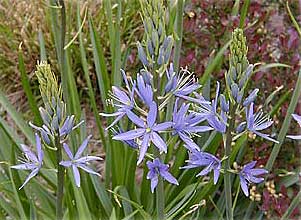
Camas in bloom
And so I think my name, having the tie with the earth, and then feeling and touching the earth, which is clay, was one of the first major passions that I’ve had about art work.
Roberts:
You might call Lillian Pitt a late bloomer. She didn’t even take an interest in her medium until she was 32 years old.
Pitt:
For about 15 years I was a hairdresser. Then I was a beauty school instructor. And in between I’d had four back surgeries and so I had to retire. And then I went to a community college.
The last class was ceramics. And so I loved the way it felt, the way it smelled. I just dreamt about it. I became obsessed with ceramics, or with clay you know, and couldn’t quite realize what I wanted to make.
The final term I made some masks and went to an opening where R. C. Gorman, the famous Navajo artist was showing here in Portland. He was very generous to me. And he said, “What do you do?” And I said, “Well, I make masks.” He said, “You do? What kind?” I says, “Well, they are clay. He said, “Well, do you have pictures?” I said, “Yeah, I have pictures. They are very awful pictures, just terrible. They are with flowers and my cat was in one. And then he said, “and do you sell these?” And in the meantime, thinking, “Oh, my god. Yeah.” And I thought, “why is he asking me all these things?”
And so, but anyway, I said, “Yes, I sell them.” And he says, “For how much?” And I thought, “Oh my goodness, he doesn’t end.”
Roberts:
R. C. Gorman introduced her to a gallery owner who liked her work, and soon her masks were hanging alongside the works of well-known native artists.
Pitt:
And so that’s been 23 years ago. And it’s been going up and down, up and down, but mostly up. And it’s just been such a blessing because I’ve been able to travel, meet indigenous people and meet all kinds of wonderful artists.
Roberts:
Pitt uses the ancient Japanese firing techniques, Raku and Anagama, for her unique expressions. But her imagery comes directly from the stories passed down by the tribal elders.
Pitt:
The memories of all the elders are very special because they are the last of the quote, unquote traditional type of people who spoke only their Indian language, and who dressed the way they dressed. And so they are all very special and we are losing them and I think everyone of them are so precious.
Roberts:
When Pitt had her first one-person show on her home reservation, her biggest concern was how the tribal elders would receive her work.
Pitt:
[Laughter] You try not to jump around and say, “Well, well, what do you think? What do you think? What do you think?” And so, I just sat there very quietly.
Bernice Mitchell, another elder, she says, “I love what you do. You’re giving our names back. You’re giving identity to us as a people. You’re doing it with honesty.” And I just wanted to cry.
Roberts:
Pitt’s message of thanksgiving, tranquility, and tradition comes across in every piece. With her use of ceramic, metal and wood, each piece has an inextricable tie to the earth. One brilliantly colored Raku mask-Pitt calls it, “Moonlight Stick Indian”-is a deep yet vibrant royal blue. But her work with bronze shows muted, earthy tones reflecting the subdued, coolness of the soil.
Pitt:
They seem to turn out exquisite without my help. As they to through the other processes of the Raku firing they divorce themselves from me and become their own spirit. And they get just so beautiful. I just love them.
Roberts:
Each mask has a theme: “Spider Woman” honors the women who hold the families together, teach the children, And who have to build and rebuild their homes.
Pitt:
And then, there is “Feather Woman” which she has an abstract eagle feather on her forehead. I just make clay feathers and put them on the head honoring again all the women that are our teachers. The Hawk Woman, and the Bird Woman, Coyote Woman, Wolf Woman, and all those. And I just do. I don’t know what it is I am going to do. Whatever happens that day happens.
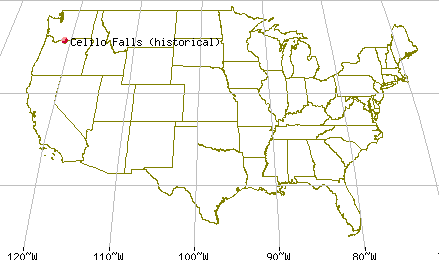
Map: Celilo Falls
Roberts:
Many of the stories that inspire Pitt come from the cultures of the Columbia River around Celilo Falls, an important fishing and trading center in the pacific northwest.
Pitt:
There was this village on the Washington side. And this was long ago when people were not yet real people, and that is where we could talk to the animals. And so Coyote came down the river to the village and asked the people if they were living well. And they said “Yes, we are, but you need to talk to our chief, Tsaglalal. She lives up in the hill.
So Coyote pranced up the hill and asked Tsaglalal if she was a good chief or one of those evildoers? She said, “No, my people live well. We have lots of salmon, venison, berries, roots, good houses. Why do you ask?” And Coyote said, “Changes are going to happen. How will you watch over your people?” And so she didn’t know. And it was at that time that Coyote changed her into a rock to watch her people forever.
Roberts:
In 1960, centuries of rock art were lost when rising waters behind the new Dalles dam flooded Celilo Falls. But “She Who Watches” sits high above the river.
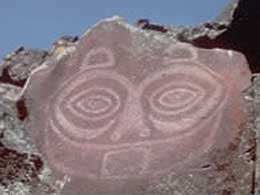
She Who Watches petroglyph
Pitt:
She overlooked the village where my great grandmother lived and so there is that personal connection with her. And she did a good job because if it weren’t for my great grandmother, I wouldn’t be here.
Roberts:
Pitt believes her talent is a privilege and that working with clay – the earth – is sacred.
Pitt:
All these images are very personal to me and very loved. And I really, every time I do ’em, it is just like a prayer of thanksgiving for my people, for the river people, for the salmon, for the deer, you know. And, it feeds my soul
Roberts:
For Wisdom of the Elders, I’m Barbara Roberts.
Neskahi:
We’ll hear more about “She Who Watches” and the Columbia River from playwright and storyteller Ed Edmo on Turtle Iisland Storytellers later in the program. You can see Lillian Pitt’s work at the Jackson Art Gallery in Portland, Oregon. Or you can check it out on the web at lillianpitt.com.