Vi Hilbert
Vi Hilbert
with Barbara Roberts
Arlie Neskahi:
This is Wisdom of the Elders. Today we explore relationships in Native culture.
Music:
Robbie Robertson
Sacrifice
Contact From The Underworld of Redboy
Capitol Records
Neskahi:It’s often said that everything in our world is connected – plants, people, even the stones and the waters that break over them. This is not new knowledge. we have been taught to observe and respect these connections. The teachings are older than memory.

Sunrise Over the Skagit River, October, 2003. Photo Courtesy of Wade B. Clark, Jr.
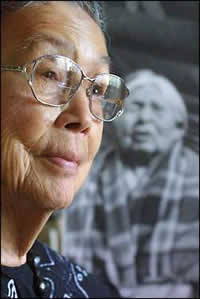
Vi Hilbert, an Upper Skagit linguist and storyteller from the Puget Sound area in Washington State, has dedicated herself to the study and preservation of the language and culture of the Lashootseed people of the Upper Skagit valley.
In today’s elder segment, Barbara Roberts presents Vi’s thoughts about the importance of relationships among the Lashootseed peoples.
Vi Hilbert:
I am Toxibleu Vi Hilbert, Upper Skagit elder, and I have five generations behind me. I am a great, great, great, great, great grandmother and I live in Seattle underneath the flight path of SeaTac airfield and Boeing field where airplanes are flying over my house constantly and dropping all kinds of polluted burned out kerosene fumes that are very unhealthy.
Roberts:
Nestled in the trees overlooking an industrial area south of Seattle, Vi Hilbert’s house has been a center of Lashootseed studies since she settled there decades ago. On a recent visit, Vi remembers growing up on the Skagit in the 1920’s.

Sunrise Over the Skagit River From Lyman, Washington, January 17, 2003 Photo courtesy of Wade B. Clark, Jr.
Hilbert:
My dad’s father had a longhouse on the Skagit riverbanks along with several other lean medicine men who also had longhouses.
These were the longhouses that held five or six or seven families, as many families as could live in an eighty, ninety, hundred and twenty foot longhouse.
And people lived together and partitioned for privacy with cattail mat partitions. They weren’t soundproof, but people learned to live together in a communal kind of living. And they cooked together and ate together.
Family came first and foremost to all of our people because this was what made life worth living, was having family and being part of a family.
Roberts:
Many cultures acknowledge that it takes a village to raise a child. In Skagit culture every individual expects the village to care for them throughout all phases of their lives.
Music:
Johnny Moses
Longhouse Welcome Song
When The Humans Thought They Were People
Ten Wolves
Hilbert:
When a child was born, it was cared for by the entire group. When a person grew old, then not just one person was responsible for caring for that life. It was the responsibility of the whole group to see that that person was taken care of.
There weren’t nursing homes. We didn’t have hospitals. We took care of each other and that was one of the things that I admired and noticed as I grew up. I saw how beauteously they cared for one another and made sure that if people were in sorrow there was somebody there to help them over the sorrowing.
Roberts:
Vi’s people believed that their responsibilities to each other encompassed more than their human family and community but included plants and animals as well.
Hilbert:
The Cedar and the Salmon. The salmon were people. Each species was known to come and go at certain times and they were honored for the lives that they gave to my people for sustenance.

Salmon Swimming Upstream Photo courtesy of: Central Westcoast Forest Society, Federally registered Canadian Charity, Photographer: Barbara Schramm, Schramm Design
Hilbert:
So we speak to the spirit of each of these things. We speak to the spirit of the salmon. We speak to the spirit of the tree and we know that these things are understood because we’re speaking to the spirit. We’re not speaking to the thing itself, because the tree is wood. It has life. Every part of the tree is valued from the root to the bark to the way a cedar gives its’ life and can be split up to create many, many things.
Roberts::
This type of bond with the environment can lead to exceptional development of skill. In the case of Vi’s grandfather, it was an unusually intimate knowledge of the Puget Sound’s Skagit River.
Hilbert:
It was wonderful to see him understand how the water worked and how to use each body of water, the still water, the rough water. I watched him read the river, read where the deep eddies were because he could tell where the deep eddies might hold a special group of salmon. And he could spear them without seeing. He knew where they were. I had to learn how to be very quiet, very still, never to jiggle the canoe, never to move but to sit quietly and listen and observe. So that was part of my teaching, to learn how to be still, to learn how to listen.
Roberts:
Vi’s grandfather was teaching her a critical component in the Skagit community — discipline. Discipline was instilled early in a Skagit child’s life with a strong emphasis on the responsibilities assigned to each gender.
Hilbert:
The woman, if she had been properly taught, knew how to handle everything that was in her domain to take care of. And she was taught this by her women family members so that they could be proud of her when she married and went to another family. She was taught never to be lazy, to always be industrious and to continue to learn how to do new things.
The man was expected to be a good provider, to be a good hunter, and the families went as a group to pick berries in the mountains, and the man had to know how to protect the family as they went out to do this because they were in competition with some of the animals. The bear was fiercely going to guard his source of berry fields, so the father was there to make sure that the family was protected from the animals who needed food also.
Roberts:
For the Skagit people, the separate roles do not translate into discrimination. It’s seen merely as an assignment of tasks based on gender. When the woman’s help was needed for the hunt, she was expected to stand side-by-side with the men.
Hilbert:
The stronger the woman, the more she was respected. The more industrious she was, the more she was honored.
I was an only child, and we didn’t have but a tiny bit of money in the family because my dad was a logger and a fisherman and sometimes there were no fish running at that particular time of the year, and sometimes there was no work in the logging camps.
Roberts:
Vi attended Chemawa Indian School, then finished high school in Portland, Oregon, while supporting herself as a housekeeper. A mother of several children, Vi has done a bit of everything. She managed a restaurant, owned a beauty parlor, and was secretary to the director of nursing at Children’s Orthopedic Hospital in Seattle. Since her parents died, Vi has focused most of her energies on preserving her parent’s culture. Now in her eighties, Vi is the foremost expert on Lashoootseed Salish and has collected and translated more than three volumes of traditional stories.
Music:
Johnny Moses
Canoe Arrival Song
When The Humans Thought They Were People
Ten Wolves
Hilbert:
I have said to many audiences that the most valuable thing I know of to do during my lifetime is to try to find some way to help my people. How do I know what kind of help they need. I know because I watch them, I listen to them, I know that they are lacking in lots and lots of information because they haven’t had time to live the culture as I have lived it.
In the old days, spiritual help was a gift that you have earned in order to make your life better, to make your life stronger, to allow you to live honorably in this world because you had the help of the spirit. So this is what the young people have mistaken as the entire thing. It’s just a part of it. It’s a steppingstone to becoming educated.
So I try to live up to what my parents have taught me to do with my life and it’s a great honor to try to fulfill their dream that their only child could do what they expect of her and know that I can never do anything wrong because they have taught me how to do things right.
Roberts:
Stories of the past with hopes for the future. For Wisdom of the Elders, I’m Barbara Roberts.
Host:
Vi Hilbert has written several books on Native American culture available through University of Washington press. Special thanks to Paul Eubanks at tenwolves.com.