This History is Ours
(speaks in language)
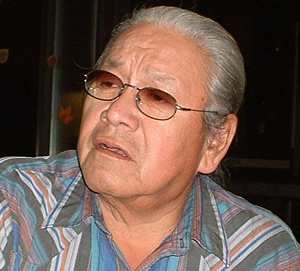 My name is Robert Four Star. When I was born they gave me the name of Good War Paint. When they made me Chief of the Red Bottom in 1981, they gave me the name of Buffalo Stops Four Times, which was the name of one of my great grandfathers.
I was fortunate as a young man to be raised in a traditionally closed society. My mother was sent away to boarding school when she was four years old until she was in the eleventh grade, but that did not deter her from teaching us children the Assiniboine language and she insisted that we learn. As we grew up we spent time, summers with our grandparents. We spent time with others of our relatives. That’s all they spoke was Assiniboine so fortunately, we spoke our language. And of course, as you grow up you assume everybody else was raised like that, which is not true.
I’m of the Red Bottom Band. The Assiniboine are patrilineal. My father was a Red Bottom, the name Four Star. And my mother is of the Fort Belknap Little Rocky Mountain Assiniboines, The history that was shared with me is they always said, ” You are not a Sioux “.
As I got older and I got educated and I started teaching at the college, I had to educate myself as to who are these Sioux’s. They all stem from the Dakotas in Minnesota. We call ourselves Nakona. N-a-k-o-n-a. We’re not Sioux’s. You read your European history books, it says that these Assiniboines were Yanktonai at one time. There was a big fight over buffalo and the ones that went north was the start of the Assiniboine tribe. That story may have been true and those Yanktonai might have joined the Assiniboines, but there have always been Assiniboine.
We’ve been in this Montana area here. This last time I think we came out here I’m guessing in the thirteen hundreds.
European history says that this Yellowstone River and this Missouri River dried up in about 1200. When we were sent out here on the plains we brought the medicine lodge with us. The medicine lodge is, the official name of that is the House of Cloth, where we plead with the Thunderbirds to bring water to the land. They say the water causes the plants to grow, and the plants growing the animals have something to eat, and so, therefore, we have something to eat. The medicine lodge which the Assiniboine, the Nakona people, do is an age-old ceremony. Very, very ancient ceremony.
We have stories amongst our people of dealings with the caveman. And we have older stories about the tipi. They call them tipi circles, the circles of rocks. Our old people say we’re the only ones that ever used those. So wherever you find those, our people have been there.
Those circles of rocks they held on the skins on their tipi.
There are stories in the Cheyennes that when they came into the Black Hills in the 1600s they couldn’t cross the river because the Assiniboines wouldn’t let them. Why we would stop people from crossing that Missouri River just doesn’t fit with the history that was taught me because we’re not that kind of a people. We didn’t sit here and fight people that came in here. Instead, it was the other way around. We helped them when they came in here and we never did the war on the Europeans when they came in here.
Our old people said that there’s a race of people coming. There’s no need to fight them. Instead, you should try to help them and learn their ways because they’re going to be in this country someday. These are the teachings that they had with us when we were young. The closed society I was raised in with my mother and my stepfather and with my own father when he was still alive, the traditional ways we were raised in, we never talked about other Indians. We never even talked about other bands of the Assiniboines. It was just the Red Bottom, which I am. When I turned fourteen I found out that there were Sioux’s and I thought, ” What is a Sioux? ” I’m very naïve about it and I found out what they were, and I thought, I wonder why nobody ever talked about them? Well, that’s the closed society I was raised in.
There’s a lot of these things that have never been written about the Assiniboine. This history is ours. People of my age now and my brother Carl, we’re preserving this. We’re documenting it. We’re finding out where all our archives are. We’re building a database so that there are kids down the road, our children, our grandchildren want to know about our people, it will be there.
Robert Four Star
Robert Four Star is Red Bottom Assiniboine, or Nakona, from the Fort Peck Reservation, located west of Wolf Point, Montana. When Robert was born they gave him the name of Good War Paint. When they made him Chief of the Red Bottoms in 1981, they gave him the name of Buffalo Stops Four Times, which was the name of one of his great grandfathers. His great-great-grandfather was the first to carry the name Four Star. Robert’s mother is from the Little Rocky Mountain Assiniboines and also the People of the Mask from Moose Mountain in Saskatchewan. The name Assiniboine is an Ojibwa word that means “people who cook with stones.” There are traditional stories tying them to the Big River Assiniboines, the mound builder people, who lived east of St. Louis. They roamed in most parts of this North American continent from the tree line in Canada to the west coast to the open prairies. Smallpox devastated their population twice in the 1700s and twice in the 1800s. Today there are about 12,000 Assiniboines left.
Robert is a singer and storyteller. He is a rememberer of songs of the Red Bottom people. He knows the history of the ancient ceremony of the medicine lodge, the grass dance, and “Inkbomi,” a mythological moral character in the tribe portrayed in stories only told at night. He has a special story about his mother’s grandfather, Little Chief, who was involved in the Cypress Hills Massacre. Wolfers followed trails of horse thieves into the hills and came upon Little Chief’s camp. Thinking the Assiniboines were the horse thieves, they proceeded to get them inebriated and then massacred them.
Robert is a historian and published a story titled “Red Bottom and Their People”. It details the powwow system that the Red Bottom people use. He wrote articles for the magazine, Montana History, which is now a collector’s edition. Robert also works with the museum in Helena, Montana to locate cultural artifacts. Robert once helped his brother, who carries the Feather/Hand Game Bundle, to have a ceremony for a 2,500-year-old woman. His wife weaves baskets from Water Willows that are now used for carrying or storing food. These types of baskets replace the clay pots that were used by the Mound People. Water Willows are also used to make cradleboards.
Robert speaks to all types of groups; high schools, colleges, and even instructors who want to know about the Red Bottom Assiniboine and where they come from. He finds that non-Indian groups are hungry to learn about this culture. He’s open to all topics, especially the history, culture, music, and language of the Assiniboine. He also serves on the Martin Luther King Day Committee for the state of Montana.
Robert has a CD, “Warrior Songs of the Assiniboine”, that was published in November of 2005. The songs are from the 1700s and 1800s and are in the Assiniboine language with interpretation.
Robert Four Star
RR Box 5008B
Wolf Point, MT 59201
406-653-1989/ home
work 406-653-3900
fourstar@nemontel.net