These Native Ways
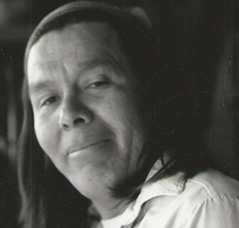 My name’s Reuben Kent, my English-given name. I’m an enrolled member of the Iowa Tribe of Kansas and Nebraska. I’m a member of the Buffalo Clan. This first case talks about pre-contact pottery and the evolution of pottery in the Midwest. This is the Early Ceramic right after archaic when they’re still wandering around hunting and gathering before they develop into agriculture and cooking, and other levels of existence where you’re not constantly moving looking for food. You develop into a technology of pottery and other means of surviving other than just constantly chasing food. It’s very wide open. It’s got a pointed bottom. Probably hand-built. I think they’ve estimated its size about eleven-point-some-odd gallons. I’m not sure how many, but anyway, it’s a nice good-sized cooking pot. The designs are related to the Hopewell people who lived around in the Kansas City area, but it was actually found a hundred miles south in the Questa regions of southeast Kansas. Hence the name “Questa Pot”. It has the bosses and the situations in this little design. Archeologists have utilized the design work to make that connection to the Hopewell people. One to two thousand years ago, AD one to one thousand. Then you get into the second, the Middle Ceramic. This is a farmer, this is when you’re hitting agriculture in a big way. All these pots have been found in Kansas.
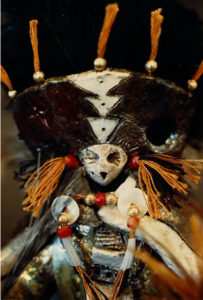 As far as the Midwest, I’d say. This is where they start talking about Onie-Ota culture. The Onie, Onie-Ota people just appeared. Nobody knows where they came from. I’m thinking an amalgamation of different people always moving and shifting. They would form their pots. Archeologists speculate that they used a stone on the inside. That’s called an “anvil and paddle” method of building. You get your pot together, and while you’re putting the clay together, and they overlap, you take the paddle on the outside, and you hold the anvil on the inside, and you hit on the clay and it drives out the air bubbles and it makes to the firing. Better chance. It also leaves cord impressions, which is what you see on a lot of the pots. That’s how they date some of them because you know they make them like that. Some of them smooth those cord impressions off and come back to put designs on them.
Some of them didn’t for various reasons. This is the tool that they used to make these clay containers. The anvil I think they used like buckskin with some sand on it as opposed to a hard stone. Stone gets heavier and doesn’t have as much give. What you’d probably wind up doing when you used a stone and paddle, you’d probably wind up flattening the clay too thin. It would not take a beating as well. When I was in Santa Fe going to school, a student of Native American arts, they gave me a choice of classes. They said ceramics or traditional pottery, I went for ceramics because it seemed more general and there was more opportunity. I got wrapped up in some of the things that they were saying; you people didn’t do clay, you didn’t have clay and that’s not your tradition. It made me think about it; all these pottery shards, and all these archeological sites that they dig and find all this stuff. If we didn’t do it, who did? So that got my interest going and I went back and started doing a little bit of research. I finally hit upon the Oni-Ota culture. I did more research with that, some of the designs, some of the speculations and thoughts of where these people came from, and how they were developed. It’s a different kind of history. It’s an interesting history because depending on the archeologists that you talk to; there are different thoughts about where they came from and how they intermingled. Some people say that there were woodlands cultures that developed. Others say that there was a group of people out of Cahokia, which is across the river from St. Louis. It’s the largest Native American cultural center north of Mexico.
I mean this place was huge. They had temple mounds that they called a wood henge, which was a large astronomy place. They had the Summer Solstice and the Winter Solstice marked. They had time to plant and they had all these things going on. They rebuilt a wall around it. I think they said it took about thirty thousand trees for one. I mean this place was huge. Twenty to thirty-thousand inhabitants at one time, but that was some of the speculations. There’s a reason they speculate that there’s a place in southern Wisconsin. It’s called Az-lan. When they excavated they found the same types of defensive walls based on the same plan that they found at Cahokia prov from St. Louis. Some people say there might have been a northern colony. It might have been a trading post. All these things it might’ve been, but it’s interesting.
Reubin Kent
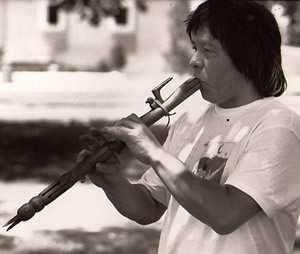 Rueben Kent is a member of the Buffalo Clan with the Iowa Tribe of Kansas. An ancestor, St. Joseph Roubidoux, was the founding father of St. Joseph, Missouri. The Iowa tribe at one time was called Ioway. They were situated on lands from Wisconsin to Louisiana first and then up and down the river roads of the Missouri and Mississippi Rivers. They are considered an offshoot of the Siouan people, also referred to as Winnebago. The tribe is located midway between Kansas City and Omaha in a picturesque part of Kansas along the Missouri River along the old Lewis and Clark Expedition Trail. Some of the best farmland in Kansas can be found in the hills and bluffs overlooking the floodplains of this region. When giving presentations to groups, Reuben likes to speak of indigenous cultures because that’s where he finds his audiences have the most interest. He likes to work with children so he can teach and stress the importance in continuity of Native American culture. He frequently discusses the differences between the woodland and plains cultures. Reuben also knows the origin of powwow and the drum. For example, when you’re talking about a drum in his culture, you’re actually talking about a kettle that’s tied up, similar, but not the same as the water drum of the Native American church. He has discovered that people almost always want to hear the history of tipis. He also tells a story of how his family came to be called Kent which is traced back to a relative named Iron Horse. Reuben is a professional artist, and his work has been published in books. His work can be found in “Native American Art” by Robin Langley Sommer, “Hands In Clay – 3 rd Edition college level text book and “Creativity Is Our Tradition” – Institute of American Indian Arts-Santa Fe, New Mexico. Reuben works with clay, does beadwork, flute carving, and is becoming very interested in stone carving as well as painting. He plays the flute and has produced a CD with many flute melodies.
Reuben Kent PO Box 32 White Cloud, KS 66094 785-442-3304 nahm@kshs.org