
How We Got Our Name
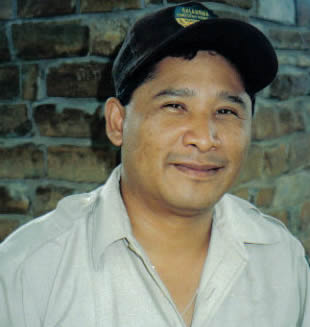 My name is Presley Byington and I’m within the Choctaw tribe here in the state of Oklahoma. I live in Idabel Oklahoma. It’s back there in the southeastern corner about 20 miles from Arkansas and about 20 miles from Texas.
I’m from the Choctaw tribe. My family came across the ‘Trail of Tears’ from the state of Oklahoma. I’m also part of Mississippi Choctaw and what that means is that there was a certain amount of Choctaws that came across on the ‘Trail of Tears’ and then there were some that stayed behind and decided to become citizens of the state of Mississippi. Later on that there were some that decided that they didn’t like citizenship as bad as the state of Mississippi so they came across it at a later date. And those who came across at a later date got the title as Mississippi Choctaw. My grandfather married a lady who was one of those who came across at a later date. On credit cards they have Choctaw and they have Mississippi Choctaw although that is all still one tribe. That gives the separation of who came across early and who came across at a later date.
How we got our last name was from a preacher because there were preachers and people who came through the Mississippi area that was a big influence on Choctaw people. Whenever they decided that you had to have a last name, some of them got to choose their last name, but because the preachers were such a big influence they picked your last name.
Presley Byington
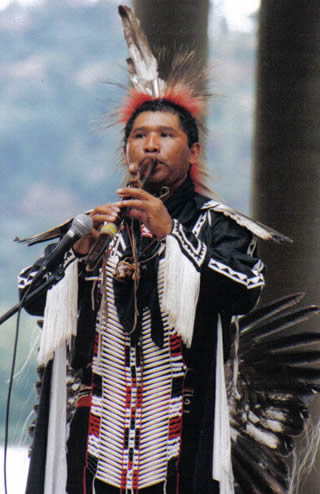 Presley Byington is a member of the Choctaw/Mississippi Choctaw tribe of Oklahoma. Living in Idabel, Oklahoma, his family came across the ‘Trail of Tears’ from the state of Mississippi to Oklahoma. The Choctaw Nation consists of eleven and a half counties in the state of Oklahoma. The south part is flat with a lot of farmlands and humid. The north part is mountainous and very pretty. Presley’s dad informed him that there was a chief in the family, Harry J. W. Belvin, who in 1948 was appointed by President Harry S. Truman. In 1971 the government decided the Choctaw people had the right to elect their own chief. Belvin ran and won his first four-year term. However, in Aug.1975 he lost his second term to a distant relative C. David Gardener. Gardner was ineligible for the first election because of the 35-year-old age requirement. He was only 31 at the time.
Presley relates mostly the oral history of his tribe in his presentations and enjoys teaching history. From what is understood the Choctaw came from the west. They wanted to leave the place they were located because it was evil. They followed two brothers, Chahta, and Chicksa, and a medicine man that carried a red pole. The red pole was stuck in the ground every evening before they went to bed and when they awoke the next morning the pole would be leaning towards the east. The medicine man announced they were to follow the pole and when the pole stood straight up and down, this would be where they make their home. It was in Mississippi where the pole stood straight. The town of Philadelphia, Mississippi is the nearest town to where the reservation is today. A large mound is known as Nanih Waiya, or Leaning Hill is located there among other mounds. Presley teaches about the mounds of Mississippi around Choctaw country and why his people were called mound builders. The Chickasaw and Creek Indians were also known as mound builders.
The Cherokee, Chickasaw, Creek, Seminole, and Choctaw played the game of stickball although the Choctaw also called it the little brother of war. It’s similar to La Crosse. La Crosse uses only one stick and stickball uses two. The ball used is about the size of a golf ball. It had two rules. The first rule decided how far the goalposts would be from one another and the second rule was you couldn’t touch the ball with your hands. The goal post would have a bird, a fish or something of that nature skewered on a pole and the players would have to knock it off or hit it to score a point. Today a plank, most likely a 1×12, stands at each end of the field and it has to be hit with the ball in order to earn points. Each team had a medicine man that would come out with a Medicine Whistle. His job was to blow the whistle, chant, and cast spells on the opposing team, and good luck on his own team. Lots of gambling went on during these games, especially by the women. The women-owned everything so they felt they had the right to bet whatever they wanted. There was some betting among the men also. After the games were over there was usually a feast. Choctaws always looked for a good reason to have a feast.
Presley also discusses the dances of the Choctaw. There were a lot of animal dances as a result of the respect given to the animals. They had war dances, four-step war dance, regular war dance, social dances, wedding dance, friendship dance, jump dance, turtle dance, duck dance, snake dance, and raccoon dance. He knows the origin of the raccoon dance, which actually isn’t that old. It was created by some children in the 1930’s who witnessed some raccoons playing in a cornfield. He also shares that Choctaw women dance with the men as a couple in the war dances. He also makes and plays the Courting Flute.
 As a Wildland firefighter Presley includes environmental issues in his presentations, believing the Great Spirit gave the Indian people the forests to protect. He has met a lot of other Native Americans out on the fire lines with the same beliefs to protect and give thanks for the forest, which has been given to the people.
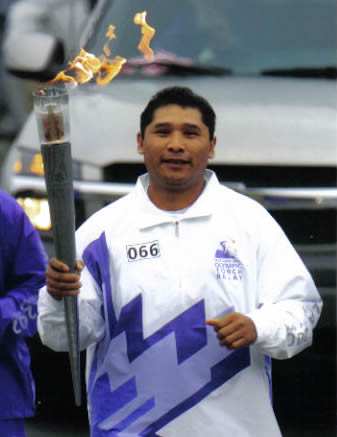
Presley was awarded Employee of the Year for the Oklahoma Department of Agriculture in 2000. A co-worker in the Oklahoma City office wrote an essay nominating Presley for torchbearer for the 2002 Winter Olympics, one of over two million nominated. He was one of 11,500 who was awarded the opportunity to carry the torch. Presley carried his torch through a portion of Hot Springs, Ark. Recently he accepted an invitation to be on the Folklife Committee for the Oklahoma Historical Society.
Presley loves children and feels they need to be taught their native history starting at an early age; therefore many of his presentations are given to children. Older people also like to speak to him after a program to talk about culture and other subjects. He also feels, when given the chance, he learns a lot from them by sitting and just listening.
Presley Byington
2301 SE Adams
Idabel, OK 74745
580-286-6364
pbyington@pine-net.com