Leo Lockwood
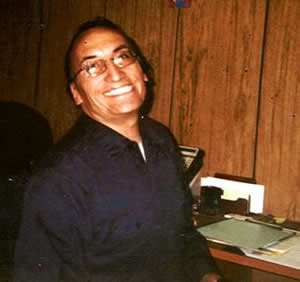 My name is Leo Lockwood. I’ve e been very involved in music. I think music has been my, one of my best strengths and it’s been one of my resources that I’ve used to kind of keep me on track as far as where I’m at today.
I think the whole influence of music started way back when I was in the third grade I was shipped off to a boarding school and at the time there weren’t very many activities and with the boarding school life, there’s a lot of peer pressure, there’s a lot of rivalry between kids and one of the things that I’ve done was that I retreated into my room for safety. They had this phonograph that you could check out and I found it more comforting to go check out the phonograph and listen to all, you know they had some classical music and kind of some up-to-date music but then just staying by myself listening to music. Then after a while, as I got a detail, one of the personnel would give me a little bit of money now and then, I bought myself a pair of drumsticks from the local music store. I put one of the album covers, I just put it on top of the garbage can, this square garbage can, and I would start drumming to the beat of the music. I’ve done that for third, fourth, fifth, seventh, eighth grade and you know, from all that time I was getting really interested in, what would you call it, the rudiments of music and drumming. I was really influenced by a lot of the musical selection that they had and I wanted more. When I got into high school, into Flandreau, they had equipment there for a band you know, drums, guitars, and amps and I’d never played on a full drum set and I tried it out and it seemed so easy for me. From just all the years of just working with music and kind of understanding how the beat goes, it came naturally to me as a drummer. Later on, I took up the base guitar and the regular guitar and just started singing music from there.
One time we played down at Vermillion at a place called the Crow’s Nest and they kind of had to get special permission to book us in there because we were all underage and as we were playing, there was this guy who just happened to stumble in the door, he was kind of drinking, and he came up to the band and he said my name is Floyd Westerman. Do you mind if I do a few numbers with you? We didn’t know who he was, but once he got on stage, he was playing all these songs, and he just kind of like, we’re just thinking gee, I wish this guy would go away, he’s taking over the whole show. I always remember that. He probably doesn’t remember us and little did I know, a few months later he came to the school with his whole band and they sounded good. He had his records and everything and it was just like, wow, man, he was right there playing with us.
Music was one of the biggest things that kept me in school. I think if it wasn’t for music because my academics weren’t that great, and I really didn’t like being in school because to me it was like, I don’t really want to do this English and I don’t really want to do this writing, but I know that this weekend I got a dance in Marty so I’m just going to hang in there so I can get that done, but I eventually did. As I got done with that, I eventually went on to community college. I got my associate’s degree and then, this school was encouraging me, go a little more, and I got my bachelor’s degree, and they kept encouraging me and I got my master’s degree, and now I’m thinking here sitting, I got my master’s degree and I’m a kid that didn’t even like school. I’m saying if that music wasn’t there in the beginning, I probably wouldn’t even have a GED and I always look at music as the stepping stone that took me a lot of places, that got me to where I’m at today.
Leo Lockwood
Leo John Lockwood lives on the Fort Berthold Indian Reservation in western North Dakota. His tribal affiliation is Arikara. His mother is Cecelia Dragswolf and his father is Melvin Starr. His maternal grandmother Mary Howling Wolf was a midwife and delivered many of the children in the tribe. She also took in many children and cared for them as her own. Leo’s maternal grandfather, Edward Lockwood, was known for his skills as a cowboy and powwow singing. His paternal grandparents, Jenny Spotted Horse and John Starr were caretakers of tribal medicine bundles. Migrating north along the Missouri River, the Arikara lived in the bottomlands before the building of the dams. They lived in earth lodges numbering into the thousands before the smallpox epidemic, which wiped out the major part of the Arikara. Today the Arikara live along the lake that was created by the dam and along the Missouri River in six communities within the Fort Berthold Reservation.
Leo is considered a historian and storyteller but prefers to be known for his interest in music. He has written songs, sings, plays drums, guitar, bass guitar, and has sung with a drum group for a short time, learning powwows and traditional songs. He feels his people have always had music in their culture. They had songs for many occasions and purposes and through songs and music expressed themselves. Songs and music are still used in ceremonies and prayers that are conducted today and not something that is just talked about from the past. The Arikara are still very spiritual and involved in keeping their culture alive.
He had the privilege to listen to his grandmother tell stories when he was very young. He remembers them and has passed them on to his children. A lot of the stories are teaching stories and legend stories using animals and also about the Creation story. Leo feels it is important for the children to know and hear these stories told by an elder family member. Hearing these stories being told to him by his grandmother has fostered a very close bond between him and his grandmother. Leo lived in Pipestone, Minnesota for some years and had the opportunity to learn from some very knowledgeable people. He was taught how to quarry the sacred red stone, fashion the pipes and stems, and care for them. He was also told stories of how the pipe was acquired and how it was used.
Leo’s storytelling includes the tribe’s Creation story. It tells of how they came from under the ground and the place was somewhere in South America. They have medicine bundles that go along with the Creation story. Whenever the tribe relocated they placed an object in the bundle to represent that area. It’s been told there are things in the bundle that can only be found in South America. When the tribe gets ready to move they hold a ceremony and the Creation story is told and every object is used to tell part of the origin story. Leo also shares the story of Chief Gray Eyes. White Shield, Son of the Star, and Grey Eyes were all Chiefs of the Arikara people. Grey Eyes was Chief when Lewis and Clark came across the Arikara in South Dakota.
Leo is very proud to say that his people were a part of a large trading hub that took place long before the coming of the white people. They were well known for gardening vegetables and other tribes came from long distances to trade with them. His people were considered very friendly people by other tribes. It is thought that the Arikara and the Sioux were always bitter enemies. When the Sioux were being pushed westward into Arikara homelands, the tribe offered the Sioux an invitation to the ceremony called making of a family, where the Sioux would become part of the tribe and gain all the benefits of being part of the tribe.
Leo Lockwood
Box 763
New Town, ND 58763
701-627-4324 hm
701-421-0103 cell
leo_lw80@yahoo.com