We Act Out the Creation Story
I’m Jerome Kills Small from the Pine Ridge Reservation in western South Dakota. My Lakota name is Sisoka Luta (shee-sho-kah Loo-tah), which translates to Red Robin, but I always say Cardinal.
 I’m from the Red Star side of the family. My ancestral grandfather is Man Afraid of His Horses and Young Man Afraid of His Horses. Young Man Afraid of His Horses had three other brothers. The first one, his name was Black Mountain Sheep, and they called him Chinska (sheen-sh-ka), Spoon, because we make spoons out of the mountain sheep horn. We boil it and make it soft, and we make ladles and spoons, and I have mountain sheep spoons and buffalo horn spoons and ladles. I keep them for the memory of what I was told, and I still live that way.
Every chance I get, I like to show off my ancestral name. A man whose horses are feared was one of my grandfathers. Young Man Afraid of His Horses, one of his brother’s names is Tashunk Kokipa pi (Tah shoon-kah Ko-kee-pah pee). In English, the name is translated as Man Afraid of His Horses. Another one was Clown Horse and these came all from a dream. The old man named all of his relatives through Hambleceya. He went to the Gray Horn Butte, what we know as Devil’s Tower. He did his fasting there and named each of these boys, and the last one’s name is Red Star, and I’m a direct descendant of Red Star on my mother’s side. We’re a matriarchal society, so we generally take the last name of the mother. So my name on the tribal rolls is Red Star and Kills Small secondary, which is my father.
When I was a small boy I remember being blind. When I was healed and I came to, I was in Kyle (Medicine Root), South Dakota, Medicine Root District, they say, and it’s Peji Haka (Peh-zhee Hka-kah) They always say there’s a lot of medicine in that Yellow Bear Canyon. It’s a big canyon down there by Allen, South Dakota. Well, we lived on the edge of Yellow Bear Canyon in Kyle, South Dakota. That’s where I knew that I was alive and the first time my mind started to record, I started to know these people. They were Grandma and Grandpa Louisa and Edward Spotted Crow. They were in their nineties when I was a small boy. They’re the ones that helped to heal me when I was blind.
A medicine man by the name of Jess Steed is the one that made me see, and I like to say his name because I’m his document, I’m his doctoral thesis. I’m his doctoral dissertation. I’m the example. I’m the document of that medicine man. So it’s up to the people to say who’s the medicine man, not the medicine man himself. It’s the people who are the documents. If many documents say that that person healed me, then he must be the right person to go to. Then we know, by that circle of people, of how our stories run, through individuals.
They would tell a lot of things, and I’d just sit there and listen, and sometimes I would hear about their travels all over this land. They even talked about depression. When there was no food, nothing could grow, a lot of grasshoppers, they tell about that. They used to say they went all the way to Wyoming. There was a store over there where things were very, very cheap, and they said that it was the Gray Medicine, Sage, Peji Hota (Peh-zhee-Hko-tah) that means Wyoming. It’s called the sage land because of the sagebrush, and they said when they went over there, they would remember when they used to go to the He Ska (Hke-skah). the Rocky Mountains. They used to go over there to look for medicine. We get the mountain sage and a lot of the medicines over there. They would come back through the Scotts Bluff area, back this way. They would tell all the places where they roamed, just to complete their shopping (you-sh-taahn), they’re going around and bringing things home for the winter.
So they were in touch with other tribes. We have relatives in Montana, in Lodge Grass, from the old days, we went through. My great-grandparents went through adoption ceremonies over there, and we’re related to the La–LaForge over there in Lodge Grass, and I go over there and they welcome me. I met a lot of those people over there. We go over there for Christmas powwow when holidays were starting to become popular when I was a small boy. So I started to see the land, where we traveled, and see those kinships. They were not of our tribe, but we had Hunka (Hoon-kah) or making of relatives ceremony with other tribes a long time ago.
So the textbooks, kind of knock it on the head that we were traditional enemies. It just doesn’t work with me, as a traditional person. I think that’s propaganda. I don’t think it’s true because we intermarried through those big trade fairs. I said, “At least they’ll peek into the window of the ancient ones, the ones who had created that foundation of respect.” That foundation was not written. The foundation of our life is written in our hearts. We have oral traditional history. It’s written in each and every person, and that’s the comfort because it’s in each and every one of us. We are the ones that tell the stories by acting them out. We are the ones who, if we say “Genesis, Creation,” it’s written down in the holy books that we have, and if they’re written down, they’re for everybody.
For us, the Lakota, and many tribes who are like us, what we do is act out creation through the purification lodge. Each time the man, who is the spiritual person, pouring the water on the stones, the breath of life licks you in there, and it comes to you. It licks you, and you feel refreshed. They put different types of medicines on them, so they’re able to, during that nostalgia of the old ones, if you lived this way, and your ancestors lived this way, for time long-lasting, then it’s probably in our DNA because some medicines, when I smell them, I would say, “You know, I smell this someplace, but where?” I forgot, on the surface level, but my say deep structure, or this collective unconscious that we all have together, in there someplace it’s informing me that we had done that before, or our ancestors did. So it’s good to see that happening to my body. My body is being reminded that somebody did this for you before, and it brings that good feeling back. So now, when I sing in the Inipi (ee-nee-pee), the sweat lodge (ceremony), and they put certain medicines on the stones, and I smell them, all of a sudden my grandma and grandpa feel like they’re in there in that dark, because I went through this with them, too, in that dark. It feels like that spirit’s there, through that smell and it feels so good to know that I’m doing the same things they did, and I’m hoping that somebody else will remember me that way. We pass on that spirituality through even smells and sound. We pass it on.
And so when they put the stones, and then the water on the stones, and the mist comes to us, I always, as a scholar of spirituality, remember even in Genesis, it says that God breathed life onto man, but we didn’t write it. We act it out. We breathe. We made it breathe onto us, and we act out the creation story all over again, the soup of life. This is how it was, a long time ago, when it wasn’t written in the books. This is how it was. We did it for time everlasting, to be able to know that it feels human. Ikce Wicasa (Eek-Cheh Wee-chah-shah), ordinary man.
Jerome Kills Small
Jerome Kills Small, Red Robin, of Pine Ridge, South Dakota is Oglala Sioux. Jerome’s great grandfather’s name was Old Man Afraid of His Horses. He had four sons; Young Man Afraid of His Horses, Red Star, Black Mountain Sheep, and Clown Horse. Red Star is the father of Jerome’s Mother. Old Man Afraid of His Horses chose his son’s names by experiences he had during Hanbleceya (vision quest ceremony) at Grey Horn Butte (known as Devil’s Tower). He is the oldest of eight children and was always raised by his grandparents. He was blind as a child until a medicine man, Jess Steed, healed his eyes. He attended Holy Rosary Mission and spent summer vacations in Porcupine, South Dakota. Originally the Oglala occupied land west of Missouri to the Big Horn Mountains south to the Platt River and north to Montana. The Lakota treaty land gradually shrank to the Black Hills area for a short time until the discovery of gold and then the reservation system was developed. Today, the reservation is next to the Badlands. The terrain consists of a range, valleys, meadows great for alfalfa, fields of corn and sugar beets, creeks and streams, and the hilly higher altitudes have lots of pine trees.
Jerome is the recipient of the Distinguished Scholar Award from South Dakota Humanities Council, Reconciliation Award from the Governor of South Dakota, George Nickleson, University of South Dakota Poet of the Year in 1994, and he has awards and certificates for speaking at Red Road Retreat and the Building Bridges Conference. He has been in several videos for Iowa State University.
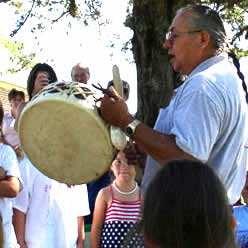
Jerome has many talents and as a traditional storyteller and oral historian, he presents workshops for both adults and children. Presently he portrays Tecumseh and Dr. Charles Alexander Eastman, the first medical doctor of the Lakota people, for the Nebraska and South Dakota Speaker’s Bureau and Chautauqua Series. He knows the origins and stories behind the flag song, patriotic songs of the Lakota, ceremonial songs, songs of the Little Big Horn, Wounded Knee, and Big Foot. He is an arena director, conducts ceremonies, and explains cultural protocol. He makes drums and drum sticks, does feather work, made the staff for the first sundance at Vermillion, and constructs sweat lodges. Jerome and his wife grow and harvest foods and medicines in the Lakota tradition.
PRESENTATIONS OF JEROME KILLS SMALL
Trickster Stories
Jerome tells funny stories of the trickster, Iktomi. Jerome acts out the story to make up for the expletives that are lost in telling a trickster story in English. Expletives are spontaneous sounds made to forecast the content of a sentence in the Iktomi story. So if Iktomi was to do something shameful a fitting Lakota expletive would be uttered at the beginning of a storyline. The sounds are absent in writing a Lakota story that was necessary to set up an expected response.
Stories for Children of All Ages
Jerome Kills Small tells the stories of his elders, and the stories they left for future generations. He tells of the memories of childhood, and stories for intergenerational history. Lakota oral tradition shows respect for animals, plants, the universe, and especially for the people. He sings songs with his elk hide drum to bring sounds of the heartbeat of all living beings and invites the audience in a friendship dance.
Patriotic Songs and Stories of the Lakota
This program tells of the stories of patriotic involvement in all the engagements of America in wartime since the Great War or World War I. Jerome sings and tells the stories of the Lakota flag songs, victory songs, sneak-up, wounded warrior songs, veteran songs, honor songs, and memorial songs. The history kept in songs is important for future generations to remember our grandfathers’ contribution to freedom.
Harvesting Foods and Medicines in the Siouan Homelands
The Siouan tribes have harvested many wild foods and medicines. The plentiful crops of the wild plants were harvested as the need demanded. Jerome tells of the harvesting and uses of the foods and medicines. The folk stories of the plants are the oral traditional way of passing on the information. Each nation has its own uses and thus the plants are universal. Mr. Kills Small says, “The plants have legs, the roots, but are intimate with mother Earth. We have legs that move on the Earth to tell the stories of the plants that feed us, heal us, clothe us, and cool us, and warm us in their loving ways.”
What do the Words for the Animals Mean in the Lakota Language?
The Lakota names of the animals describe the attributes, or ways of the animal. There is encyclopedic and cultural information by knowing the animal’s name. One example is the name of the rabbit in Lakota: Mansincala, the small animal faces east and seems to await the sun early in the cold morning, thus we have manste, or sunshine in the name, then call is anything that is soft and lovable. The animal tells us by his position in the morning which direction is east. The presentation goes through a series of animals and tells the story behind the name.
The portrayal of Dr. Charles Alexander Eastman
Dr. Charles Alexander Eastman is the first Dakota medical doctor. His grandmother, Uncheeda, and his uncle Mysterious Medicine cared for him on their escape to Canada during the 1862 uprising. His father Face of Many Lightnings, who was believed to be hanged with the thirty-eight or perhaps died in the uprising, surprised the family by arriving in Grandmother’s Land (Canada) and took his son home with him to his farm in Flandreau, SD. From thence, and in seventeen years, Ohiyes’a, Charles, made transitions to become the first medical doctor of the Isanti Dakota. Dr. Eastman was the physician at the Pine Ridge Indian Reservation during the Wounded Knee massacre or battle. Some of the topics of the portrayals are Spirituality; Education; Technology; Change During Trying Times; Father and Son Reunion; Stories of Uncheeda and Uncle Mysterious Medicine, who raised Charles in Canada.
Portrayal of Tecumseh
Mr. Kills Small portrays Tecumseh, Shawnee chief, and British General, and discusses the Shawnee resistance of the long knives who arrived over the Alleghenies. He tells of Danial Boone’s capture by Tecumseh’s father. Tecumseh brought fifty-one tribes together on horseback in an attempt to create one of the greatest alliances of Native Peoples. Tecumseh side with the British and was made a general. He was very sensitive to the protocol of the peace mothers of Shawnee and did not allow the torture of American prisoners of war. The time covered is 1790 to 1813, when Tecumseh lost his life at the Battle of Thames in Ontario, Canada.
Placenames of the Oglala Lakota
Jerome discusses the stories behind the placenames of the Pine Ridge Oglala Lakota. This presentation is filled with humor and tales of families in everyday life. He tells of the prairies where his grandfathers and grandmothers traveled. Kills Small tells of the change that has come over the land in a very short time.
The Origin of Songs
Mr. Kills Small sings traditional, powwow, rabbit, and other songs and tells their meanings and stories of their origins. This presentation has much humor, and a more serious ending with appropriate public encouragement songs and tells the originators of the songs. Jerome sings a very good selection of songs for each dance category and explains the regalia of each type of dance.
Powwows!
Jerome is a powwow organizer and brings his own drum groups and dancers for dance demonstrations or an all-out powwow. His group performs at many gatherings in South Dakota, Nebraska, Minnesota, and Iowa. On request, they are equipped to bring their own sound system and have seven teepees for a full effect in the summer gatherings. They have stories tellers, flute players, a hoop dancer, and category dancing from the differing styles of dancers in their group. They travel with their own announcer and arena director.
They have performed for graduations, honoring, and are at ceremonial gatherings throughout the year.
Lakota Culture
Mr. Kills Small explains the values of the Lakota and how they are parallel in meanings to American values. He, then, tells the differences and the protocol necessary for Lakota expressions of values. He discusses the seven sacred rites of the Lakota and how they tie into all human values.
Gerome Kills Small
209 S. Plum St.
Vermillion, SD 57069
605-261-4184
jkillsma@usd.edu