Sweet Medicine
 My name is Gordon Yellowman, Sr. and my Cheyenne name is (L), which means ‘Yellow Hawk’. I’m a member of the Cheyenne and Arapaho tribes of Oklahoma, but I’m also a traditional leader among the Cheyenne people in regards to membership. I serve as a traditional chief to the Council of Forty-Four, the traditional peacemakers of the Cheyenne people.
Cheyennes have been really historically known to be coming from the Great Lakes Region area. That was their traditional ancestral homelands. As at the beginning, we were known to be farmers – horticultural people. We planted squash and beans and lived on different plants in that Great Lakes regional area. There are some accounts that are different or are similar in regards to scholarly written materials, but most of our Cheyenne history, our oral historical accounts, are related through oral stories.
One story that I want to touch on and talk about is our Cheyenne prophet, Sweet Medicine. Sweet Medicine was a very powerful person. He was a medicine man that was the one that gave us a lot of the teaching of the Cheyenne way of life—our traditional ceremonies, our language, and our traditional laws that would govern us as people as we progressed in the future.
Sweet Medicine, (L ), is how you say his name. He was a culture hero among the Cheyenne. He started his life among the Cheyenne as a prophet at a very young age and he took refuge at the sacred mountain, (L), Bear Butte.
That was where he was taught inside a cave and stayed there for a period of four years. While he was inside this cave he was given special instructions, teachings, and gifts from the supernatural power of spirits. Those spirits are the ones that guided him and told him, “These are going to be the ways of life for the Cheyenne people”.
It was very exciting for him to be receiving these instructions for the Cheyenne people. Receiving is something that is still practiced to this day in our traditional manner as a giveaway. Anytime we do something honorable or we recognize them, in honoring them we always give gifts to honor that person in regards to whatever their accomplishments may be.
During this teaching and during this receiving the instructions as to how we were going to live as people, there was a lot of so-to-speak a lot of predictions that were given to him by these spirits. These spirits had told Sweet Medicine what these predictions were going to be. He said the Cheyenne people are going to face certain things. What he meant by that was, they were able to tell him the future and not only one generation, but several generations as well. That’s how far these teachings and predictions were going to reach. Today they are still reaching us as current generational people.
One prediction that he said there was going to be other tribal persons. That meant other tribes were going to approach a dark-skinned person and a light-skinned person. Teaching that Sweet Medicine received was very religious, teachings of a ceremony that he had, but became known as the Sacred Renewal Ceremony. He also that time received the four sacred arrows along with his religious teachings.
Sweet Medicine was in regards to his predictions. One of the predictions that were told by the spirits was they told him that there were going to be different types of animals coming. These animals are very different from some of the animals that you’re facing today.
First going back to what the other prediction was, there’s going to be people coming to face you as Cheyenne. That person is going to have long hair on his chin and on his legs. He’s going to carry with him sickness of all kinds and he is coming to you in the future. What he was talking about was the White man. The White man is now with us. He’s put us through a lot of atrocities and deprivations.
With the White man, there’s going to be an animal that has flashy eyes and a tail that touches the ground, and one hoof on each foot. This animal’s going to be coming and be very restless. The hairy person, the White man, will also be restless. Do not try to be like them, is what he told us, Cheyenne. This hairy person will also bring a spotted animal with horns, big eyes, and a long tail that will also touch the ground. This animal will live on dirt and eat anything. If you take after it and eat it, you will also eat almost anything else.
He prophesied the future of the Cheyenne in this language, “My brothers, and children and all my people of this earth listen and remember my words for they are as true and sharp as the points of the great Sacred Arrows. Always keep in mind my prophecies, my predictions of the future. As long as your people and the earth last, then you, as Cheyenne people, will never become extinct. As long as the blue heavens, the sun, moon, and earth last, you will always be here.
Please do not forget the Sacred Arrows. Remember them always and no other. You are instructed to renew these Sacred Arrow sticks annually. That is still with us today. This ceremony is still among us today and has brought us this far in life, but also in generations. It will continue to do so because we, as Cheyenne people, continue to uphold these traditions, our songs, and our language, our ceremonies. With that intact, we will always be Cheyenne and there will always be Cheyenne.
One of the things that I mentioned earlier in my story was that I am a Cheyenne chief. Cheyenne chiefs were also in Sweet Medicine’s prophecy. He also received teachings and instructions on how the chiefs should carry themselves, how they should organize so that there will be leadership within the tribe. To this day we still have the Council of Forty-Four, the traditional peacemakers of the Cheyenne.
So being a chief is an honorable thing, but it’s also a very humble thing because you have now the responsibility and duty to take care of your people from the youngest to the oldest. That sometimes can be very burdensome because we may not be able to meet or exceed the people’s expectations in caring for them, but nevertheless, that is what we have to do as traditional leaders. That is our role as a Cheyenne chief. We have to look out for the benefit of our people or the safety. Whatever they may be facing it’s the leader, a chief that has to do that. He always puts his people before him. He never puts them behind him. That is still practiced to this day.
I’ll give you an example of what I meant by that. When we’re at a gathering or we’re at a traditional meal, having a dinner, whether it’s a funeral, a social gathering, or during ceremonies, the chief is always last to eat and his people eat before him first, starting with the children to the adults, to the elderly. After all of the people have eaten, then he is the last to eat. So that’s what I say as an example, as to the traditional roles and responsibilities of putting our people in front of us, has always been the foremost duty and responsibility of serving as one of the peace chiefs of the Council of Forty-Four.
It’s very honorable as I mentioned, but also very responsible. You have to be a strong person to really become a sound leader for your people. I was always taught that. Respect your people and always continue to talk to them. Always continue to greet them. Always continue to love them. In turn, they may respect you a little, but always uphold that highest regard and respect to your people because that respect has to be earned. Respect is earned in an honorable way and that is also one of our teachings.
We still have great respect today for our Cheyenne people. We have respect for our elders, our children, especially our warriors—those that are serving in the armed services, the men and women among our tribe that is serving in Iraq. We have great respect for them, but we also mutually respect one another as leaders.
There are as I said, other traditional groups. There’s the Kit Fox, the Bowstring, the Dog Soldier, and the Elks. They are societies that are also within the Cheyenne organizational societies of our people. I just touched on a little bit of the chiefs’ society because I said I am a member of that society. It’s been very unique to survive a lot of atrocities, but we’ve also had a lot of tremendous leaders back in the past that were men of caliber, I always say.
For instance, Chief Black Kettle lost his life at the so-called Battle of the Wichita of 1868, he was a leader, but yet he put his life on the line and lost his life on the line for his people. That was for the love that he had for his people. He was promoting peace and died promoting peace. To this day we honor him. Because of him having the love for us for ourselves as Cheyenne, we continue to honor him today as that Peace Chief leader. He is highly regarded as that person as being a peacekeeper, a Peace Chief for the Cheyenne.
Those is some of the small narrative or story that I can share with you today and if we had more time then we would certainly continue these little stories. I hope that this story can help in some way to educate the general public, but also educate others that may not be aware of who the Cheyenne people are.
So with that, I want to say, “(L). Thank you.” Aho.
Gordon Yellowman, Sr.
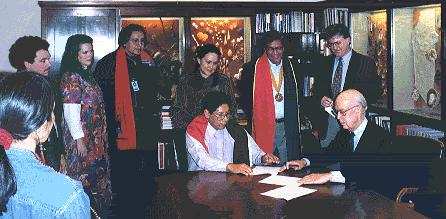 Gordon Yellowman, Sr., Yellow Hawk, is the grandson of Josie Limpy, former Sacred Hat Keeper of the Northern Cheyenne, and great-great-grandson of Chief Sharp Nose and nephew of Josephine White former Sacred Pipe Keeper of the Northern Arapaho Tribe. Gordon’s father the late Everett Yellowman, Spotted Skunk, served as a Chief Sundance Priest for 35 years and member of the Council of Forty-Four, the traditional Chiefs and Peacemakers of the Cheyenne. As a young boy, Gordon was taught by his grandparents, parents, and elders the traditional values of the Cheyenne and the Arapaho. Gordon received the honor of being selected as one of the Cheyenne Chiefs at the age of 16. Today, Gordon continues to serve as a Cheyenne Chief. He has also worked for the Cheyenne and Arapaho Tribes of Oklahoma since 1979, continuing his education at Oklahoma State University in Architectural Technology, and currently serves as the tribe’s Transportation Planner.
Gordon is an artist, guest museum curator, and exhibit consultant. He incorporates the Old Cheyenne and Arapaho ledger art style into his unique contemporary ledger art style. Cheyenne’s ledger art represents a significant transition from drawing/painting on buffalo hides to a paper medium. The art training and experience of Gordon includes research and study of Cheyenne Ledger Art. He works in various media including acrylics, technical illustration pens, prism colors, and watercolors. Gordon has been a juried artist in the Red Earth Art Festival since 1994.
He won the Red Earth ‘2000 First Place Award in the miniatures division for his miniature ledger book, titled Chief Yellowman’s Ledger. In one project, he worked with the Cheyenne people, and authors to produce an unprecedented book on the Dog Soldiers, including ledger book drawings as historical documents. Yellowman collectors include citizens of the U.S., Canada, Germany, Switzerland, and Poland.
Gordon began Repatriation work in 1991 since the inception of the Native American Graves Protection and Repatriation Act (NAGPRA) of 1990 and the 1989 National Museum of the American Indian, Smithsonian Institution. Gordon was the first Cheyenne to be designated by the Cheyenne and Arapaho Tribes of Oklahoma as their NAGPRA Representative. He is a Speaker and instructor on issues dealing with sacred sites and consultation with federal agencies on cultural resources, also a member of numerous groups. He serves as a National Historic Preservation Act (NHPA) Representative for the Cheyenne and Arapaho Tribes of Oklahoma.
As a cultural advisor and consultant Gordon contributes tremendously to Museums and Federal Agencies throughout the United States.
ART EXPERIENCES AND SHOWS
- Featured Artist 2005 Southern Plains Indian Museum, Anadarko, Oklahoma
- Illustrator 2005 Jumping Mouse: Journey to Recovery Working Book, Joan Candy Fire
- Featured Artist 2004 American Indian Art Calendar
- Selected Artist for Book Jacket Design for “Tell Me Grandmother” by Dr. Virginia Sutter, University Press of Colorado in Boulder 2004
- Third Place Award, Graphics/Photography 2004 Watonga Cheese/Art Festival
- First Place Award, Graphics/Photography 2003 Watonga Cheese/Art Festival
- Third Place Award, Graphics/Photography 2003 Watonga Cheese/Art Festival
- Selected Artist for Design of 2003 Cancellation Stamp titled; Cheyenne Dog Soldier United States Postal Service
- First Place Award, Digital Photography 2002 Washita Symposium Art Show
- Second Place Award, Watercolors 2002 Washita Symposium Art Show, Cheyenne, Oklahoma
- Artist, 2002-03 Native Art Show, University of Oklahoma Sam Noble Oklahoma Museum of Natural History, Norman, Oklahoma
- Selected Artist, for Design of State Highway Sign, Logo “Cheyenne Heritage Trail” Oklahoma Department of Transportation and Oklahoma Department of Tourism.
- Juried Artist, 1994-2003 Red Earth Indian Art Festival, Oklahoma City, Oklahoma
- Master Artist, 2nd Annual 2001 Red Earth Master Show
- First Place Award, Miniatures Division 2000 Red Earth Indian Art Festival, Oklahoma City, Oklahoma
- Featured Artist, 19th Annual 2001 Exhibition of the Gallery of the Plains Indian
- Featured Artist, Mabee Guerrer Center/Museum in Shawnee, Oklahoma, 1999
- Featured Artist, Plains Indian Museum in Woodward, Oklahoma, 1994
- Book Jacket Artist/Design for “The Eagle Catcher” by Margaret Coel, University Press of Colorado in Boulder 1995
- Illustrator, University of Oklahoma School of Social Work Publication, 1981
- Best of Show, Watonga Art Festival, 1978
- Commissioned by the City of Watonga to paint a mural for the City Hall Building, 1978
Gordon Yellowman, Sr.
Cheyenne and Arapaho Tribes of Oklahoma
P.O. Box 137
Concho, Oklahoma 73022
(405) 262-4794 ext. 205
Toll Free: 1-866-CAROADS
gordonyellowman@prodigy.net