
Rodney Howling Wolf and Virgil Chase. Photo by Milt Lee.
Rodney Howling Wolf and Virgil Chase
with Brian Bull
[audio:https://www.wisdomoftheelders.org/s2_progs/204_ew.mp3]Arlie Neskahi:
The passage of time can dry rivers, collapse trees, even crumble mountains. But for Arikara tribal members Rodney Howling Wolf and Virgil Chase, it can also build and strengthen a friendship. Both Rodney and Virgil recollect growing up together in North Dakota’s “Indian country”, attending ceremonies, learning oral history from elders, and even finding their home town swallowed up by flood. The men know that while much of their childhood now lies under water, their trust and respect for one another is everlasting. Brian Bull has more.
Brian Bull:
Rodney Howling Wolf lives in a small house in New Town, North Dakota, the grassy bluffs host a number of cabins, grain towers, and a casino. Howling Wolf’s childhood pal, Virgil Chase, helps himself to another cup of black coffee. He tilts his thick leather hat over his silverish locks, and listens to Howling Wolf discuss his lineage.
Rodney Howling Wolf:
My name is Rodney Howling Wolf. I’m 64 years old. I’m from White Shield, North Dakota. I belong to the Arikara tribe. My mother was Mabel Bear Howling Wolf. My father was Dan Howling Wolf. My grandfather was Lawrence Howling Wolf. And my grandfather Lawrence was a minister, one of the first ministers out of Fort Berthold Indian Reservation. And he preached at Congregational Church in Nishu before we got flooded out. Virgil and I, we lived down in Nishu before this dam came.
Bull:
Chase puts his coffee mug down, and recalls his own relatives.
Virgil Chase:
My name is Virgil Chase, Sr., and my father was Frank Chase. He was a Mandan Hidatsa Sioux. On my mother’s side, she was the daughter of Red Bear. Red Bear was a scout. Immediately after his father’s death, Red Bear went through the Sundance torture in order to be his father’s representative. He enlisted at Fort Stevenson in 1872.
Bull:
Howling Wolf also has a scout in the family who served with one of the old west’s most familiar figures.
Howling Wolf:
The first veteran in my family was Howling Wolf. He was a scout for Custer. He was at that Little Big Horn. They said they didn’t want him to go because his horse was poor, but he went anyway. And he went on that expedition to the Black Hills.
Bull:
Howling Wolf says Custer promised provisions and aid to the Arikaras if they helped him in his search for gold in the Black Hills.
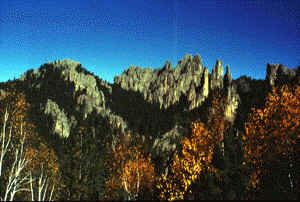
Black Hills. South Dakota. Courtesy of the National Parks Service. www.nps.gov
Howling Wolf:
My grandfather used to tell me that the Black Hills belonged to the Arikara at one time. And that the Sioux overran us, overpowered us, and we had to go back east again. My grandpa, his name was Ralph Wells, Sr. He said when them scouts had that gold, they decorated their horses with that gold. And they’d come into camp where Custer was, and Custer almost had a heart attack. He seen that gold. So, he wanted to know where they got it. So our people went and showed him. And then they said they’d fill up a satchel full of gold for us, just the Arikara tribe, no other tribe, just us. We never were paid for that gold. It’s supposed to be in the Smithsonian Institute yet.
Bull:
Gold was found in the Black Hills and settlers poured into the region by the thousands. The Sioux nations and other bands would retaliate against Custer in the bloody battle of the Little Big Horn in 1876, but life was forever changed for the Indian people.
Following the close of the Indian wars, the Reservation system was imposed on tribes. Many struggled to retain their culture despite efforts to eradicate it. Both Chase and Howling Wolf say, as children, they weren’t always able to attend or remember the traditional ceremonies practiced by their relatives. But Chase does recall a prophecy passed on to him by his grandmother.
Chase:
She passed away in 1949, so all of what she seen hadn’t come to pass yet. But she said, Nishkati was my Indian name, Black Eagle, at that time. She always said, you know, “Black Eagle, there’s a time coming.” This Missouri River that you see, it was brown, you know. It was fierce.
But she said there’s a time coming when that water would run backwards and turn blue. And when that water did, as greedy and as fierce a fighter as the magpie bird is, there was white birds coming, just like the white people were coming. And they were going to drive out the magpie, and they would take over this area. It would be laden with white birds, but she didn’t know what they were.

Lake Oahe. South Dakota. Courtesy of the U.S. Geological Survey. www.usgs.gov
And at that time, when the water runs backwards and turns blue, there was a generation coming. I would be an old man by that time. And that generation that’s coming, she said, they would not know their tongue, nor would they know their culture, or their ways. For instance, if an old person fell or something, they’d all laugh and push him down. They had no respect for one another. They had no respect for the female of the people. They would fight them and so forth.
And see now, that generation is here now, because no one knows anything anymore. No one cares. No one has respect for one another.
And see how did my grandmother know that? And everything has come to pass now. You look at the whole world. The whole world is out of balance.
Music:
Bull:
Virgil’s recalls how parts of the Arikara tradition began to fade among the tribe. He says many clans are disappearing because the younger people didn’t care to learn and practice the ceremonial ways. He remembers the Bison Bear Clan attending one final gathering in 1946 when many other representatives were missing.
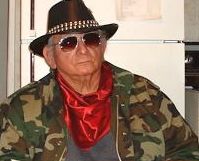
Virgil Chase Virgil Chase. Photo courtesy of Milt Lee.
Chase:
And it was pitiful. Everyone was crying. I was a little guy sitting by my grandma’s knees. And I tried to get tired and I’d try to sleep, and she’d hit me to stay awake. “Say awake,” she’d shake me, “and watch.” And I’m glad she did, because I seen all the items that was on display there. And then, all the empty spots between where the clans were no longer there.
Bull:
Adding to the loss of ceremonial practices and clans, Arikara residents of Nishu saw their town lost to dam development on the river. Virgil remembers how his mother fought to save a remnant of their community during the town’s evacuation.
Chase:
Everyone was leaving and crying. Some of the old people didn’t want to go. And we got ready to go and mom said to stop at the Ceremonial Hall. She didn’t want to forget the stone, the medicine stone. We stopped there to get it, and my brothers got off and started to try to pick it up. But they couldn’t pick it up. It was pretty heavy to lift it, you know.
So mom went back and she had a bad knee. She was on a cane. She was elderly. But then I noticed she talked to that stone in a different language. It was a clicking sound. I never did get it. It was a clicking sound. And she patted that rock around and lifted it up with one hand, like a feather, and put it in the back of the truck. And my brothers looked at each other. None of us said anything.
Music:
Along the River
Keith Bear
Lewis & Clark: Sounds of Discovery
Chairmaker’s Rush (Makoche)
Bull:
Chase says for all the suffering, betrayal, and loss the Arikara people have experienced, they are a nation of survivors who will never disappear.
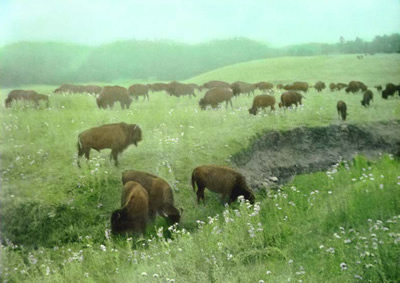
" Buffalo at Wind Cave National Park, Black Hills, South Dakota, 1948." 1948. The Northern Great Plains, 1880-1920: Photographs from the Fred Hultstrand and F.A. Pazandak Photograph. Courtesy of America's Library. www.americaslibrary.gov
Chase:
Why? Why are we still here? The reason why, is the Creator keeps us here, because we pray. At the beginning of each day, we do our prayers. We offer smoke. At the end of each day, we do our prayers again. And that’s what my job is to go ahead and get the young people interested and make them knowledgeable as to these thoughts.
Bull:
Both Chase and Howling Wolf know there’s a part of Arikara history that won’t be coming back. But they say keeping the essence of the tribe alive all comes down to faith and family – treasures worth more than any gold ripped from the earth.
For Wisdom of the Elders, I’m Brian Bull.
Neskahi:
Brian Bull is assistant news director for Wisconsin Public Radio, and is an enrolled member of the Nez Perce tribe. He lives with his wife, two kids, and three cats in Madison, Wisconsin.