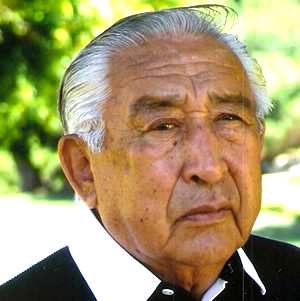
Barney Old Coyote
My name is Barney Old Coyote. I’m a Crow Indian. I’m from the Crow Reservation in Montana.
 In 1942 when my brother, Henry and I came home on a furlough before we went overseas, in a ritual that goes back into the tribal past and into the more recent practices, they had one of those old scouts do what we call a “warrior’s blessing” for us. He did not fight at Little Big Horn, but he rode with the cavalry. He was what we called a scout or, an enlisted man. My own grandfather was an enlisted man. He fought at the Battle of Rosebud with General Crook, and he was one of the two Crows wounded at that battle. So Old Coyote, my namesake, where I get our surname was a member of the U.S. forces. So I knew some of them personally.
So if you’d kind of visualize Crow country at the time after they were separated from the Hidatsa they settled here in the mountains of southeastern Montana, beginning at Bozeman and coming this way to what is now Sheridan, the Big Horn Mountains. When you think about that, the main camp of the Mountain Crows was anywhere from here west to Bozeman. The River Crow were along the Musselshell on down to the mouth of the Yellowstone. We had a band northwest and then to the north and east. The Kicked in the Bellies, the Lodgegrass and Wyola people were over in the Big Horn Basin there on the south side. What they did was literally guarded the mountains. They surrounded the mountains. The access was in the south, east, and north and they had people all around there. They didn’t have villages or anything, but they roamed that area and kept patrolling it and they shared it with other people. There was none of “you stay out”. They say, “You come in peace, we let you go in peace. But if you come in here and try to take over, we’ll have to do something about it.”
They stood together and I characterize them as a true melting pot of Indian people. They welcomed other tribes. You belong to the Crow tribe as a state of mind, not by blood, not by heritage, not by birth even, because people come to the Crow tribe. If they decide to accept that way of life, they became Crows. I’m a product of that.
I came from about five generations. Before I came along, there was a Sioux woman in the family tree. We’re descended from that. About four generations back a Piegan, a Blackfoot, man was ah, in the, in the family tree and ah, that’s where Old Coyote comes from. Old Coyote himself was literally half, half Piegan. And ah, when you take a chief of the Crows by the name of Sits in the Middle of the Line, also known as Blackfoot, Blackfoot Woman. He’s the one who signed the treaties at Fort Laramie and ah, he ah, had a Sioux wife. And that’s what we’re descended from. So we’re mixed. But they decided to be Crows, and ah, it was a state of mind like I say. Not so, so as I sit here, I’m probably forty-two pounds Sioux and maybe thirty-eight pounds Piegan.
Number one, that ah, they are a separate independent, and specific Indian tribe today, but they came away from the Hidatsa. And that ah, that separation happened probably over a thousand years ago, not before five hundred that anthropologists have been putting on us. They say that ah, it was not a one-time thing neither, that it was a gradual thing, that Crow country as we know it today, ah, is the scene of events where we were still Hidatsa and even to the time when the animals walked and talked, and the birds walked and talked. And ah, even though during, during that time the stories talk about places on the Crow today that we can go to physically and geographically, and say this is where it happened.
They say in later years events happened here that have become legendary because of the storytelling and a retelling, and kind of lose sight of the real story. They don’t know whether it’s legend or, or true. And during that period it happened in this country also. And ah, it’s either the Crows credit the ah, separation to the search for the sacred tobacco plant. The story goes that ah, two brothers went on a fastback in Lake country. And ah, they had a visitation ah. Non-Indians like to call that a vision quest. We don’t call it a vision quest. We call it a visitation. It could be a dream. It could be a delusion. It could be delirium or actual experience, or whatever it is. But what they see and follow becomes their guide spiritually. So these two brothers had very similar experiences. And the one brother saw the corn and the ceremony surrounding it. He stayed there with the Hidatsa. The other brother saw the sacred tobacco plant, mountain plant, and ah, used that as a, as the means of worshipping ah, through a certain ceremony. And we characterize that as a separation. The real separation of the tribe.
I sold you a book. Ah, these stories are the first ones to be published by a publishing house ah, as a Crow would tell the story. And I’d like to say this if you don’t mind. Ah, there are many books published about Crows and quotes written by Crows. But you look at those books and they’re not told from the Crow side at all. Ah, my
So my point is this, all these stories that we hear passed through a non-Indian person, so you get a non-Indian perspective. Plenty Coups, written by Frank Bird Lindeman, a giant in the Indian literature world, but when he told those stories, he was ah, he was disappointed as I told you. Because Plenty Coups would not say, “I did this, I did this. I’m pounding my chest. I’m the greatest.” He wouldn’t say that. He let others tell him about him. Then he would confirm it. And ah, he didn’t quite like that. Secondly, um, here was Plenty Coups with all the honors that a Crow could gather, the greatest at that time. So great that the Crows elected never to have another ah, traditional chief because he was the last of a kind. And ever since then we’ve never had a chief. We have chairmen, presidents, CEOs, and all that, but never another chief because he earned his right the old way. We can’t do that anymore.
My granddaughter wrote that book that I just sold you. These stories were told by traditional Crow storytellers. My brother and I translated them. Then my granddaughter took them, edited them and she was an undergraduate, but they published the book. And now when people read them, they say, “This is like listening to those storytellers and hearing them talk English.” That’s the difference. And therefore the Crow tribe accepted this book. And they use the book, the title of the book, and the essence of it to honor returning veterans. Crow Fair last Fall ah, they took great big ah, banners with that book’s title and cover, just like you have it, and they used it to honor the veterans of the Crow. The first time that the Crow has embraced a book written by other Crows.
Barney Old Coyote
“In the Oral-Experiential World of Native America, stories are the heart of tribal culture. At 78, Barney Old Coyote carries on that defining tradition. Some of the stories he shares were told to him by his grandmother, Medicine, and he has shaped and created others with his own pen and vision.” Excerpt from the magazine, Cowboys and Indians, January 2003, article written by Jackie Bissley. Even though his interests run far and wide with education as a high priority, Barney’s storytelling continues as a signature feature in his many involvements, including but not limited to the following.
PUBLICATIONS:
- WAY OF THE WARRIOR: Phenocia Bauerle, editor, Univ. of Nebraska Press, 2003. Barney translated these Crow stories from the Crow language to English. Formally adopted by the Crow Tribe. The first book was written by a Crow tribal member to be accepted by the tribe.
- FRED E. MILLER: photographer of THE CROWS, Nancy Fields O’Conner assembled catalog, Carnan VidFilm, 1985. Barney identified pictures in the collection and consulted in the writing.
- CROW INDIAN PHOTOGRAPHER: The work of Richard Throssel. Peggy Albright, author, Univ. of New Mexico Press, 1997. Barney was a leading consultant in identifying the photos and writing of the legends and narrative(s).
- ART IN CAMAFLOUGE: works of Bev Doolittle, Greenwich Village Press, 1999. Barney consulted on the meaning of the art and the writing of the legends.
- NAGPRA PROJECT: Little Big Horn College, Plenty Coups Museum and, Custer Battlefield Museum, and a significant number of others. Barney was a leading consultant and authority for several years running in the ’90s and 2000’s.
MUSEUMS AND COLLECTIONS:
- Smithsonian Institute, Washington, D.C. and Museum of the American Indian, Heye Foundation, New York City. Barney began identifying photographs of the Crow Indians and other tribes, 1977 to now.
- Field Museum, Chicago. Barney continues to consult on the collection.
- Peabody Museum, Harvard University, Cambridge. Barney consulted on the collection of the Crow articles and photographs.
- Southwest Museum of the American Indian, Pasadena, California. Barney consulted extensively with the curator and staff and exchanges visits during the Annual Crow Fair and at other times.
- Barney Old Coyote is a continuing consultant to the Montana Historical Society, Big Horn County Museum and others.
Barney was a singer, dancer, Master of Ceremonies, announcer and authority all his life. These activities were from coast-to-coast and over most of Indian country. His extensive knowledge of songs and dances is called upon frequently on a continuing basis. He conducts ceremonies, seminars, workshops and retreats as an authority on Crow and traditional cultural issues. He also conducts pipe ceremonies and warrior’s homecoming rituals for the tribe as in the inauguration of elected Tribal Executive Officers, December 2004 and the Historic Reunion of the HIDATSA-CROW-KIOWA Tribes, June 2004. He has been honored many times for work with Indian issues and causes. Montana State University, Bozeman cited him for “being a spokesman of excellence across language and cultural barriers”.
Barney Old Coyote is a decorated veteran of World War II and gave the keynote address at the Pentagon, November 2000 during the celebration of Indian participation in the US military. He is a retired Civil Servant, Bank President, and Director, and Founder, Native American Studies, Montana State University, Bozeman, Montana. He was a special assistant to the Secretary, US Department of the Interior, Assistant Area Director and Superintendent, Bureau of Indian Affairs. Barney is a continuing member of the Crow Culture Committee.
In response to government infringement upon Native rights Barney and his brother, Henry Old Coyote initiated the American Indian Religious Freedom Act in 1974. The House of Representatives and the Senate passed the act, in 1978 as a joint resolution. Barney Old Coyote has been a catalyst in reassembling the spiritual framework of Native America. Today as a modern-day warrior, he continues to fight for the national recognition and preservation of historic Crow sites.
Barney Old Coyote
PO Box 238
Crow Agency, MT 59022
406-652-0283