Joe McGeshick
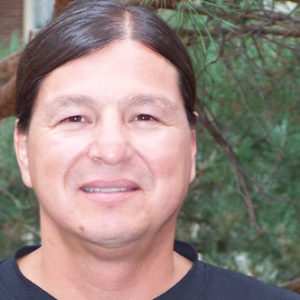 I’m Joe McGeshick. Born and raised here on the Fort Peck Reservation. Forty-two years old. I’ve been in Indian education for about twenty-five years, taught high school and college level. Currently teaching at Fort Peck Community College, Native American Studies and History. Attended universities at Montana State University and Washington State University. Also taught at both of those institutions. Moved back here to Fort Peck Rez five years ago and been here ever since.
The Assiniboine had been in contact with Whites for fifty years before Lewis and Clark were fur trapping and trading with Frenchmen who had stayed on after 1863. The French and Indian War when Britain 1763 comes to dominate pretty much the continent, the western half of the continent, and what we know as Canada today through the Hudson’s Bay Company. After the French political force is moved out after 1763, most Frenchmen stayed and they are hired by the Hudson’s Bay Company. So we have Frenchmen working for the British there in the fur trade and which they’d been before that time with their own country.
Most of the Assiniboine are initially coming in contact with Frenchmen who are working for the Hudson’s Bay Company. When Lewis and Clark come up after they united, the American Republic is founded and they obtained the Louisiana Purchase so they want to explore this whole area. Obviously the Assiniboya, and the Assiniboine, and their country, Assiniboya is just a small area the whole expanse that Lewis and Clark’s expedition is trying to map out and understand.
It’s a part that becomes actually kind of separated from its main area once the border in 1819 is drawn, or as the Indians call it, the Medicine Line. They referred to it as the Medicine Line. What it does is that politically it kind of cuts off the lower Assiniboine down here in what are the States. In fact even today most of the Assiniboine are in Canada. Even today we have two groups that are the southern vanguard of Assiniboya, which there were many bands residing here. We see the remnant groups residing here on Fort Peck and on the Fort Belknap Reservation.
Most of the Assiniboine was north of what they call the Medicine Line which is the Canadian 49th Parallel. The reason why they called it the Medicine Line and that term really comes into play much later in the nineteenth century when groups like Sitting Bull were trying to escape the government, you know the capture from the American government. And a lot of times they’ll ride across the border and then the soldiers would stop. Or vice versa. You know you’re out in the middle of nowhere and then all of a sudden they stop pursuing you? That’s big medicine.
According to that story, the oral tradition claims that the Assiniboine saw Lewis and Clark. The first story that I heard though was that they actually came in contact with them and told them to keep going because they were afraid of smallpox, which seems reasonable, but obviously that’s not anywhere in the journals. Lewis and Clark would have not neglected to write something of that magnitude down because they don’t meet any Indians in Montana except the Shoshones. On the way back the Blackfeet and the Crow, but on the way over none, zero. I mean they go for about four and a half months without seeing one live Indian and this is Indian country. Well, because you know they’re going through Missouri and the mosquitoes and they complain about them. They’re complaining about the mosquitoes and naturally, the Indians are not immune to them and so they’re not going to hang around and so they’re up in the high bench country north of the river where the buffalo are as well.
This is Assiniboine country the oral culture story says that they had watched them and actually scouted. A scouting party had seen them and reported back to one of the bands, these lower Assiniboine bands, and told about them. It’s not like they’re, you know, Martians from Mars. Indians know about White men. They’d been dealing with the French and British for fifty years or so before Lewis and Clark and so it’s not anything new to them. It’s a new group of people and wondering what their intentions are is probably what’s going through their minds. But as far as being overly concerned I doubt if the whole Assiniboine nation, which was close to about thirty thousand I suppose at that time, it really didn’t make much significance to them because most of them were up in Canada anyway. What made the difference to them was the trade that they were already engaging in and had been for a couple of generations with the Hudson’s Bay Company. So this really is an insignificant expedition. It is to us now today of course, but back then it was probably nothing to them.
They come up and they supposedly see them and they will report back and this is the story that, what I call a pageant, this production had been a taken. Which is okay I mean. You can’t refute a story that says we saw you, but you didn’t see us. You know, how do you deal with that historically? So it’s part of the oral culture and you can take it as the oral culture and you can build off that if you want, or you can choose not to. I myself choose not to because there really isn’t a lot. We can all conjecture certain things, what could have happened. What’s important is what did happen and how can we find that out.
Joe McGeshick
Historian and storyteller, Joseph Robert McGeshick, is an enrolled Sokaogon Chippewa (Ojibwa), his father’s tribe, and grew up on the Assiniboine and Sioux Reservation in Wolf Point, Montana, his mother’s reservation. Today he lives in Bozeman, Montana, and works at Montana State University-Bozeman in the Native American Studies Department. On his father’s side, Chippewa ancestors, Big Martin (kichiwabeshashi) and Big Eagle (kichimigizi) signed a number of treaties trying to save their traditional land, which caused the Sokaogon Chippewas to be landless for about 80 years until the 1930’s when they were given a reservation under the Indian Reorganization Act. They occupied the lake areas southeast of Lake Superior. There was deer hunting, wildlife, fishing, and wild rice. Wild rice was their mainstay. Rice Lake produced enormous amounts that helped keep them alive during the time that the tribe was not federally recognized. His mother’s side, the Assiniboine/Sioux, a buffalo, and horse culture, occupied the plains of northeastern Montana. The Assiniboine, which is actually a Chippewa term meaning “men who cook with stones,” called themselves Nakona. The Sioux called themselves Lakota or Dakota. The reservation in Fort Peck today has about 2 million acres of land.
Joe shares Assiniboine history and tells about the mountain man found by the Assiniboine. He had been lost for a while, his moccasins were tattered, he had no ammunition and he was starving. They took him in, fed him, clothed him and he lived with them as one of their people. He was named Lone Whiteman. He proved himself and became an Assiniboine and lived with them for many years. The Assiniboine thought that he would stay with his people, wasichu – white man or “fat takers,” but he stayed with the Assiniboine and died an Assiniboine.
Joe delivers presentations to audiences of all types and ages. Presentation topics can include anything from sweat lodge stories, pow wow song and dance, traditional dances for men and women, and the history of arts and crafts. The Chippewa used birch bark in their arts and crafts and were also skilled canoe makers. The Sioux did beadwork and quillwork. Joe is interested in ethnobotany – plants and harvesting and how to make good wild rice. He believes that cultures are determined by the environment and how it affects the health of people. You are what your environment allows you to be. He also likes to focus on Sacagawea. She’s a symbol of unity and is considered the First Goddess of the American West.
Some of Joe’s achievements are a past board member of the Montana Historical Society Indian Advisory Board; chairman for Wolf Point Indian Education Committee; recipient of the Native American Writing Award from Yellow Bay Writers Conference; the Fish Trap Writers Award; Graduate Achievement Award from Montana State University Foundation; the Phyllis Burger Scholarship. He has published many poems and short stories, and presently is working on a book of poetry called “The Indian in the Liquor Cabinet.”
Joe McGeshick
PO Box 674
Pony, MT 59747
406-209-5590
jmcgeshickponymt@hotmail.com