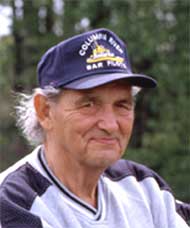
Cliff Snider. Trail Tribes.
Cliff Snider
[audio:https://www.wisdomoftheelders.org/prog308/mp3/308_tis.mp3]Cliff Snider:
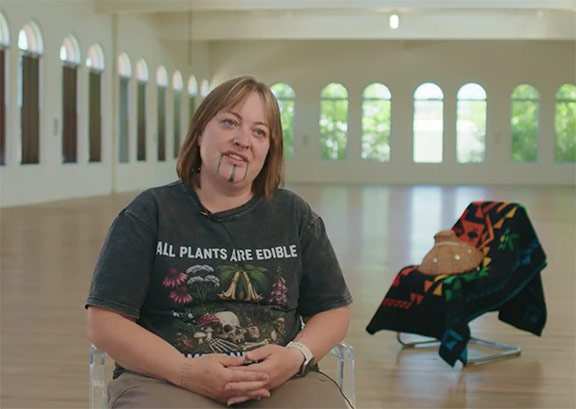
Klahooya, everyone! My name is Cliff Snider and I am the honorary chief of the Chinook Indian Tribe.
My fourth great grandfather was Chief Concomly that met Lewis and Clark in 1805. Well, I always say they discovered the Lewis and Clark expedition at that particular time at the mouth of the Columbia River. And he was the most famous Chinook Indian chief of all time.
Arlie Neskahi:
Today on Turtle Island Storytellers, we join Cliff Snider, honorary Chief of the Chinook Indian Tribe, who tells us ancient legends about the origins of the Chinook. Off mic, he tells us how the Chinook peoples originally lived in the Pacific Ocean. Every season, they would turn themselves into salmon and come up the river, where their relatives, the Indians, would harvest them, eat them, and then throw their bones back into the river. The salmon would then swim back to sea where they would turn into humans again.
Snider:
As Lewis and Clark came down the river, they found the Watlas, the Wasukles, Skilliutes Cathlamets, the Wahkiakums, the Lower Chinooks, and the Clatsops, and so at that particular time there were over 16,000 Chinook Indians living on the river. And actually, they didn’t live in one camp like Sitting Bull with tipis and many tribes around him, but they lived in little villages along the river at the mouth of every stream. And there might be 40 in a village, 50 in a village.
Quinault Reservation. Rez Enterprises.
And as everyone knows, the Chinook had one of the best canoes in the world. And, in fact, they were so good, that when the white man later built their clipper ships, they patterned the shape of their clipper ships after the Chinook canoes. And they were the fastest ships in the world. When Lewis and Clark came down the river in those logs that were hollowed out, they were no match for the Chinooks.
I also have another famous relative and his name is Selowish he was a chief at Skamokawa. And so actually my hereditary runs, my family tree runs back to two different chiefs on the lower Columbia.
And I have another famous relative who is Ilche, who is Concomly’s favorite daughter. And her name was moon woman. First it was moon girl and then moon woman. And her statue is along the Vancouver waterfront, along the walking trail. And I helped the sculptor, Eric Jensen, of Scappoose, change her. We had a cone hat on her head and she was in clay, of course, and I asked him to take the hat off and to let her hair flow, and put beads in her ears, and trinkets in her nose. And of course, the cedar bark skin mantle around her. And she is really a beautiful woman, and now she is the queen of the Columbia in Vancouver.
The story about her goes is that one day she said that the white man would come, and the rivers would flow, and the red fish would come no more. And this has happened now since we have put in all of our dams. And so the prophecy came true.
And when the white man came with the disease, Ilche took many of the tribe to the hills to escape the disease. And that is probably the reason why we are still here today.
The Tribe now was recognized and we were all allotted on the Quinault Reservation in the early 1930’s. And my mother was allotted, I was allotted, and all my relatives were allotted. Had eighty acres and some even more. So we were recognized by the United States Government at that time.
Sometimes, I am asked a question, where the Chinooks really came from. We know they have been here over 10,000 years according to carbon dating. And if you really want to know and put it into perspective, that’s 8,000 years before Jesus Christ.
Old Man South Wind, long long ago, was traveling north along the Pacific Ocean and eventually neared the mouth of the Columbia River. And there he met Giant Woman and told her he was hungry. Giant Woman had no food, but she lent him a net and told him he could catch fish in it.
Old Man South Wind headed to the great waters of the Pacific. When he got there, he unfolded the net and he drug it along the ocean floor until he caught a fish. It was not an ordinary fish, but a small whale, which Old Man South Wind brought ashore and begun to cut. Giant Woman, who was present at the scene, instructed him to slice the whale lengthwise from head to tail. But Old Man South Wind was so famished that he ignored Giant Woman, and because it was quicker, drew the knife over the arc of the whale’s back from side to side.
Suddenly the fish turned into a monstrous bird. The bird then rose into the air, flapping his wings so powerful that they shook the earth. As he climbed, bird monster blotted out the sun. Soon Old Man South Wind and Giant Woman saw that it was really Thunderbird. They were in awe of this great bird as they watched it fly to the mouth of the Columbia River. There atop Saddle Mountain, Thunderbird laid a large nest and laid several eggs on it.
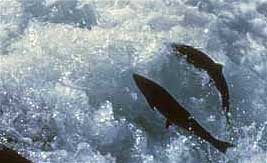
Columbia River Salmon. Photo by Les Brown.
One day, when Thunderbird flew away, Giant Woman climbed high to the bird’s nest. She mischievously cracked an egg, but it was bad and she threw it down the mountain. She cracked another, and another, until she had broken them all, and hurled them from the peak.
Each time the leg landed at the base of the mountain, it became an Indian. This is how the first Chinook men, women and children came to be.
Another story I’d like to talk to you about is on my Indian button blanket given to me by Kathryn Harold Trow, one of the elders of the tribe. The legend inscribed on my button blanket is this.
Once when the world was very young, Raven, Killer Whale, Beaver, and Eagle decided to have a picnic. At this time in the world, things were not as we know them now. There were no oceans or continents and nothing familiar to us. But there was a very high mountain from which the gods could watch how the world grew.
Eagle decided to have a picnic on top of the mountain. All the creatures arrived, each bringing his own food. Everyone put his food in a big pile with all the food that others had brought, everyone that is, except Eagle. He arrived with no food in sight, just carrying a small basket under his wing.
The others sat around and talked and laughed, but not Eagle. He just sat quietly and every once in a while, when he thought he was not seen, he dipped his beak into the basket and just as quietly withdrew. He said not a word.
Now Raven, who is a very gay talker, enjoyed a joke, became a little worried about Eagle and kept darting little glances out of the corner of his eyes at Eagle. He soon saw that Eagle must have something very wonderful in his basket, so good that he had to look at it from time to time to see if it was still there. Raven became so worried that he just had to do something. So he lured Eagle into putting down his basket and coming over to the main group. Quick as a wink, Raven was over to Eagle’s basket and scooping it up and putting it under his wing. He flew away with it.
And the basket was the first water in the world. As Raven flew away with it, the water spilled out of his basket and fell to the dry earth where it became ponds, river, seas, and oceans of the earth. That is how water came to the earth.