Indian Church, Lone Pine Tree Village, 1959.

Indian Church, Lone Pine Tree Village, 1959. Gladys Seufert Photograph. Courtesy of Oregon Historical Society. http://www.ohs.org/education/focus_on_oregon_history /RLO-Document-Indian-Shaker-Church.cfm

Lorintha Umtuch

with Nico Wind

[audio:https://www.wisdomoftheelders.org/prog304/mp3/304_tr.mp3]

Arlie Neskahi:
A crowd gathers in a plain hall with rustic wooden benches and floors. An altar is situated at the front, and a pot belly stove at the side. A collection of bells, hand-held school bells, are assembled on the altar, with a cross and three candles. Everyone prays and sings in their native tongue. On today’s Tribal Ryhthms, we are privledged to get a rare glimpse into the music of the Shaker Church, one of the few nineteenth century indigenous religions that are still practiced across the Northwest. Nico Wind has more.

Nico Wind:
John Slocum was an off-reservation logger and a member of the Squaxin Tribe near Olympia, Washington. In 1881, he claimed to have taken ill, died, and miraculously, to have come back to life. He began preaching a doctrine inspired by visions he had while he was in the after life. he built a church a year later. Again he fell ill, and again he recovered. This time, though, the people pointed out that it was his wife’s shaking that was really the source of the power that healed him. Mary Slocum’s contribution to the establishment of this religion also became the source of its name. The shaking was interpreted as a manifestation of the Holy Spirit and became an important part of Shaker services.

The Shaker Church was officially incorporated in Washington in 1910. It is one of many Native American religious communities that use music extensively in their gatherings. In the prayers and hymns, frequent reference to God and the Holy Spirit are intermixed with layers of Native cultural beliefs and customs. More than just a social construct, it is a living, breathing tradition that is the center of many Native lives today.

Lorintha Umtuch:
My first vivid impression of the Shaker Church is when I was a little girl, my dad asked if we wanted to go to the Shaker church. They usually have meetings after 8 o’clock. So we went to White Swan which is about twenty-seven miles from where we lived.

Nico Wind:
Lorintha Umtuch is a Yakama Native who was raised on the reservation by her parents. She’s a tribal judge, and she knows the traditions and the dreams of her people. She deeply understands the multifaceted nature of the various – and sometimes conflicting – religious landscapes in the northwest.
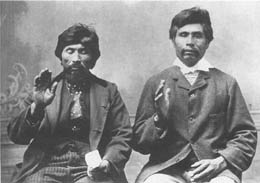
Indian Shaker Leaders John Slocum & Louis Yowaluck

Indian Shaker Leaders John Slocum & Louis Yowaluck. CourtesySmithsonian Institution National Archives 3021. http://users.wi.net/~census/lesson24.html

Lorintha Umtuch:
It’s all lit by candles, and we have shaker bells up front. And one side of the room is where the women sit and the other side of the room is where the men sat. So they start singing their songs and the people walk up front and grab bells and they start ringing the bells and they would sing the songs. And when you first start out, there’s not that many people, maybe twenty, but by the end of the evening, you have about eighty people in the Shaker Church. They sing and dance and when they’re ringing the bells and they’re dancing, they say they’re shaking.

Nico Wind:
The Shakers maintain some practices that are common to other native religions. Shakers practice purification and healing rites. Both the Shaker Church and the Longhouse Religions celebrate first fruits ceremonies. The Shaker hymns, the bells, and the rhythmic movement create an atmosphere of spiritual inspiration.

Lorintha Umtuch:
To hear the bells and hear the people singing, it just fills you up. Because the bells, they have different size bells. The men have two bells they ring with their hands, and the women have their bells too. And they are lined up on both sides of the hall and they sing and dance and when they are ringing the bells and dancing the, they say they are shaking. The men are wearing big boots and the women are wearing sturdy shoes and you just hear the sound of the bells and the feet going at the same time. And they sing these very melodious and beautiful songs. And it’s beautiful and you can just get caught up in it, because the songs are so beautiful.

Delores Martin:
Shakers are really strict. 1910s are strict. They can’t gamble. They can’t drink. They can’t smoke.

Nico Wind:
Delores Smiscon Martin, born in 1924, is the daughter of a Shaker minister from White Swan, Washington.

Delores Martin:
In the Shaker way, you can’t explain it, because like God would say, you have to pray for what you want to know. You have to pray for everything that you want to know, and you pray for it and it’ll come to you.

Nico Wind:
Delores remembers traveling as a little girl to The Dalles on the Columbia River during fishing season and attending services at the Shaker village.

Delores Martin:
Went clear over to The Dalles, to this island. They called it Waatsaps. And we stayed there. And people used to come there. It was well-built then at the time. No benches, nothing. One side mens and one side womens. They, and they ah, had their Sunday ceremony.

Nico Wind:
Shaker village, a ramshackle collection of weatherbeaten buildings behind a motel, still stands today in the shadow of the giant Dalles Dam. It’s silent here. Hot winds are working to pull the walls apart. But you can sense the spirit that moved here and still moves across Indian country.

For Wisdom of the Elders, I’m Nico Wind.

Wisdom of the Elders 2026 Summer Newsletter A paid internship, now enrolling. Plus elders' voices, mapped to the land they came from.
Wisdom of the Elders, Inc

What We Plant, We Pass On

Wisdom of the elders Multimedia Services

Greetings, Friends of Wisdom,


The summer season has a way of moving fast, and this season has been no exception. Between fieldwork, new partnerships, and the everyday work of listening and preserving, our community showed up for each other and for the land we share.


We're grateful for every hand that helped make this season count, and we're glad to share a bit of it with you here. 


Our Wisdom of the Elders archive continues to grow, with new conversations from our tape collection making their way online – elders speaking in their own words, no interruptions, no filters. There is something about hearing a story the way it was actually told, at the pace it was actually told, that no summary has ever managed to hold.


We've also been out in the field this summer with our Indigenous Traditional Ecological Knowledge (ITEK) crew, capturing the land stewardship and ecological knowledge work that grounds so much of what we do.


Stephanie Craig


We spent time with Stephanie Craig, a 7th-generation Kalapuya weaver and an enrolled member of the Confederated Tribes of Grand Ronde, documenting her basket-weaving practice for an upcoming series, Seven Generations of Knowledge, carried in a pair of hands.


Watch The Featured Video
ITEK Partners

It Takes Many Hands

We're also proud to be part of the BRANCH Coalition, a group of organizations working together on invasive species removal, native plant restoration, watershed stewardship, and care of urban green spaces across the Portland area.


Our partners in this work include Portland Parks, Urban Forestry Project, Connecting Canopies, The Blueprint Foundation, Depave, Friends of Trees, Verde PDX, Columbia Slough, POIC, APANO, BPI PDX, and the City of Gresham. It takes many hands to care for this land well, and we're grateful to do so alongside organizations that share the same commitment.


Wisdom Digital Archive Initiative 

Multimedia: Putting 30+ years of Archival footage on the Map

Behind the scenes, we're preparing our full video library for a larger public home so more people can access this work. Our web team is also building out a major piece of our Digital Archive Initiative: an interactive online story map that will let visitors explore our archive by place, connecting oral histories, video, photographs, and traditional ecological knowledge directly to the land they come from.


The stories will no longer live in a list. They will live where they happened so that someone can open the map, find a place they know, and hear an Elder speak about it. It's one of the more ambitious projects we've taken on, and we can't wait to bring it online.


Board of Directors and our Wisdom Radio Program

We're also working closely with our Board of Directors on a full relaunch of our Radio Program, with plans to bring it to every major platform, making it easier than ever to listen wherever you are. Stay tuned; this one's been a long time coming, and we're excited to share more soon.


2026 ITEK Fall Internship

Fall 2026 Indigenous Traditional Ecological Knowledge Internship Enrollment is Now Open!


We're excited to announce that enrollment is officially open for our Fall 2026 ITEK Internship, and we can't wait to welcome our next cohort! We're accepting applications from anyone passionate about Environmental Conservation & Restoration and how Wisdom integrates Indigenous Traditional Ecological Knowledge (ITEK) into our work.


This paid 12-week program combines hands-on fieldwork with partner organizations, along with in-person and online sessions covering ITEK, STEAM-related concepts, and Native American cultural arts and plant knowledge. Interns earn $19.00 an hour. It's a hands-on, heart-forward opportunity to build real skills while deepening your connection to land and community.


Spots are limited, so don't wait! 


You can read more about the program here and apply here


Questions are always welcome. Contact 


dawn@wisdomoftheelders.org and carmelina@wisdomoftheelders.org


We can't wait to see who joins us this Fall!


ITEK VIDEO

Save the Date 

Wieden+Kennedy: Dec 5, 2026 

Seeds of Wisdom Event


There's one more thing we've been building toward, and we're glad to finally share it.


Later this year, we'll gather in person for Seeds of Wisdom, our end-of-year fundraiser, hosted at Wieden+Kennedy here in Portland. Wisdom of the Elders is creating an event centered on Indigenous storytelling, environmental stewardship, and workforce development the same three threads that run through everything you've just read. It felt right to bring them into one room.


We're looking for partners who want to support meaningful community impact while helping amplify Native voices and leadership in Portland and beyond. If that sounds like you, or like an organization you're part of, we would love to hear from you. We're building our partner roster now, which means there's still real room to help shape what this evening becomes.


***As a note for those who have supported us through Willamette Week's Give!Guide in past years, we're not part of Give!Guide this season. 


We've Joined Earth Gives


Earth Gives is a nationwide platform connecting donors with organizations advancing solutions for people and the planet.


It is a natural fit for us: our work has always lived where cultural preservation and ecological stewardship meet the archive and the watershed, the storyteller and the seed, and Earth Gives puts that work in front of people across the country who care about both. 


Our end-of-year giving runs through Seeds of Wisdom and Earth Gives and we hope you'll join us there instead.


If you've been looking for a simple way to support what you've read about here, this is it.


Want to stay closer to what we're up to day-to-day? Find us on Instagram, Facebook, and YouTube; more is coming there soon, including TikTok and Threads.


There's more coming this fall. Thank you for being part of it.


Wisdom of the Elders, Inc.

Portland, Oregon

wisdomoftheelders.org


Donate Today

Join Our Community: Follow Us!

We are growing our digital community and want to stay connected with you! Follow us for updates on our latest films, internship applications, and environmental restoration projects across the Portland Metro area.

Copyright @ 2026 Wisdom of the Elders, Inc, All rights reserved.

3917 NE Shaver st. Portland, Oregon 97212